

Valve’s Steam Machine launches in 2026: Everything we know so far
The Steam Machine is back from the dead. Not as a Valve-supported program for manufacturers to create living room PCs, but instead as a home console sibling to the Steam Deck. Valve introduced its second attempt at ruling the living room in a surprise hardware announcement in November 2025, and paired the new Steam Machine with a new Steam Controller and a wireless VR headset it calls the Steam Frame. Since the announcement, as is often the case with Valve, some details remain elusive, however.
While we wait for the release of the company's new hardware lineup in 2026, and more information straight from the horse's mouth, here's everything we know about the hardware, software and price of the Steam Machine, so far.
What's the Steam Machine's hardware like?
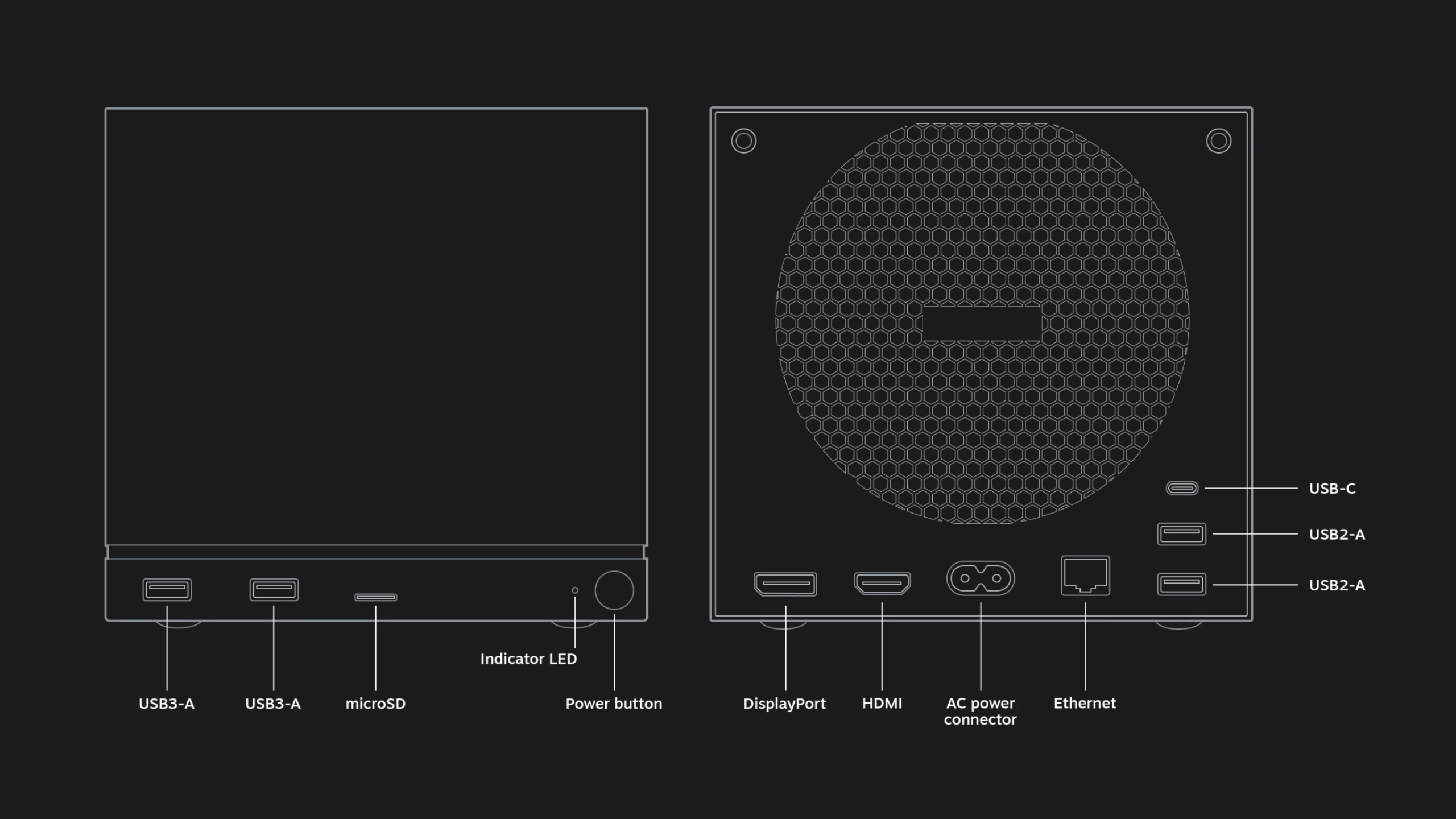
Like the Steam Deck, the Steam Machine is utilitarian and bespoke. The PC is a black, 5.98 x 6.39 x 6.14 inch (152 x 162.4 x 156mm) box, with ports and a grille for a fan in the back and a removable faceplate and customizable LED light strip in the front. Inside, Valve says the Steam Machine features a "semi-custom" AMD Zen 4 CPU with six cores and up to 4.8GHz clock speeds, and a "semi-custom" RDNA3 AMD GPU, along with 16GB DDR RAM, 8GB GDDR6 VRAM and either 512GB or 2TB of storage.
While these specs make the Steam Machine more powerful than the aging Steam Deck (which shipped in 2022 with its own custom AMD chip) Valve has been careful not to oversell the capabilities of the box. In a blog post, the company said that "the majority of Steam titles play great at 4K 60FPS" using AMD's FidelityFX Super Resolution (FSR) frame generation and upscaling technology, but some titles require more upscaling than others, and it "may be preferable to play at a lower framerate with [variable refresh rate] to maintain a 1080p internal resolution."
In a hands-on preview of the Steam Machine, Digital Foundry expressed concern with what Valve's claims and the device's stated specs could mean for future performance. "The decision to opt for 8GB of GDDR6 memory has been proven to be a limiting factor on many modern mainstream triple-A games and falls short of the maximum VRAM pools and memory bandwidth available on both Xbox Series X and base PS5," Digital Foundry writes.
The Steam Machine supports Bluetooth 5.3, Wi-Fi 6E and includes an integrated 2.4GHz adapter for the new Steam Controller. In terms of port selection, there's DisplayPort 1.4 and HDMI 2.0 inputs for connecting the box to external monitors and TVs, four USB-A ports (divided between two USB 2.0 ports and two USB 3.2 Gen 1 ports) and one USB-C port on the back.
Engadget will have to try out the Steam Machine to really know what it's capable of, but there's nothing to suggest it couldn't be as flexible as the Steam Deck, especially with more power to play with.
What games will be able to run on the Steam Machine?

Any game that runs on SteamOS, Valve's Linux-based operating system, will run on the Steam Machine, provided the device's technical specs will support it. For games running natively on Linux, the Steam Machine will download the Linux version. For Windows games and everything else, it'll be able to use Steam's built-in Proton compatibility layer to translate games to Linux, just like the Steam Deck does.
Proton is developed by both Valve and CodeWeavers, the team behind the macOS compatibility app CrossOver. Valve's compatibility layer translates a game's API calls and other software features into something Linux understands, essentially tricking the game into thinking it's running on Windows when it isn't. Proton has worked remarkably well so far, in some cases helping some PC games run more efficiently on Linux than they do on Windows, but it does have some limitations. Because some anti-cheat software doesn't support Linux, many competitive multiplayer games aren't playable on SteamOS. Valve hopes the Steam Machine will help change that.
"While [the] Steam Machine also requires dev participation to enable anti-cheat, we think the incentives for enabling anti-cheat on Machine to be higher than on Deck as we expect more people to play multiplayer games on it," Valve told Eurogamer. "Ultimately we hope that the launch of Machine will change the equation around anti-cheat support and increase its support."
To help users find what games work well on the Steam Machine, Valve plans to expand its program for verifying games on the Steam Deck to include the Steam Machine and Steam Frame. Valve looks at things like controller support, the default resolution of the game, whether or not it requires a separate launcher and whether the game and its middleware work with Proton to determine a game's rating. Then the company sorts games into four categories: Verified (where the game works with Steam hardware at launch), Playable (where a user might have to make modifications to run smoothly), Unplayable (where some or all of the game doesn't function) and Unknown.
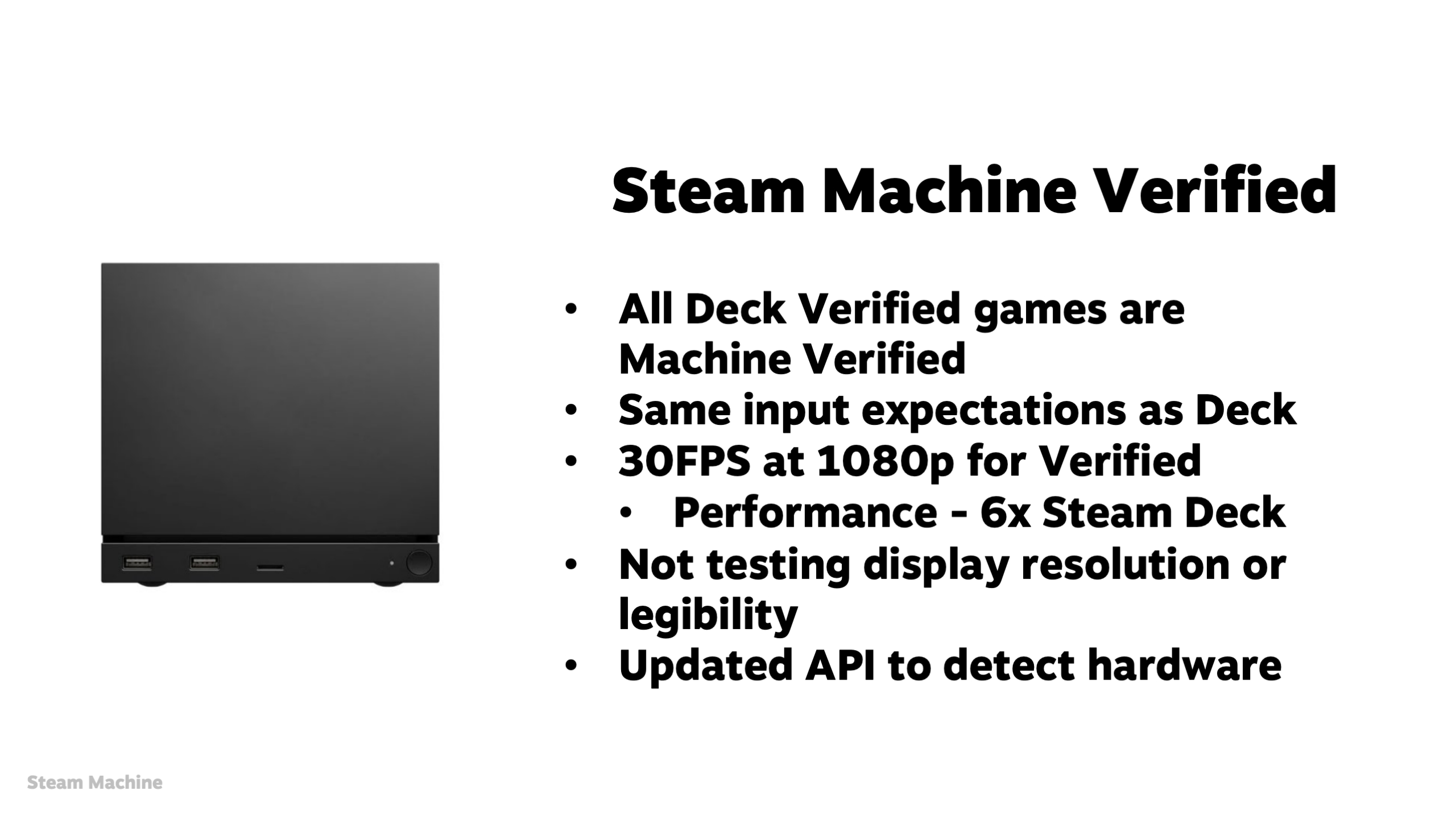
According to an announcement Valve sent to developers in November 2025, games that were Verified for the Steam Deck will automatically be verified for the Steam Machine. In a presentation at GDC 2026, the company also shared that Steam Machine Verified games will be expected to support the same input methods as the Steam Deck and run at 1080p at 30fps at a minimum. Unlike the company’s handheld, Valve won’t require developers to support specific display resolutions or meet legibility requirements to be Steam Machine Verified, though, because the Steam Machine is more likely to be connected to larger displays. That means a game could be marked as Playable on the Steam Deck due to its small text, but Verified on the Steam Machine.
Valve’s system is helpful, but far from definitive — some Unplayable games are in fact playable on the Steam Deck — which is why online, community-run databases like ProtonDB fill in the gaps with more granular information.
How much will the Steam Machine cost and when will it launch?

Valve hasn't announced a price or a release date for the Steam Machine or any of its new hardware, beyond affirming its new hardware will ship in 2026. In terms of price, however, the company has suggested it might not be a deal in quite the same way the $399 Steam Deck LCD was. Valve designer Pierre-Loup Griffais told The Verge that the "Steam Machine’s pricing is comparable to a PC with similar specs" and that its price would be "positioned closer to the entry level of the PC space" but be "very competitive with what you a PC you could build yourself from parts."
That means the Steam Machine will likely cost more than the $499 PS5, and that the rising costs of memory could make it even more expensive. Valve has already publicly admitted that memory and storage shortages are affecting its plans. In February, the company said that it was delaying the launch of its hardware (though it still hopes to ship in the first half of 2026) and rethinking pricing, particularly around the Steam Machine and Steam Frame, because of the "limited availability and growing prices" of critical components like RAM.
The changes Framework had to make to the pricing of the Framework Desktop are an illustrative example of the position Valve is in. Framework pitched its compact desktop PC as being great for gaming, with an AMD Ryzen AI Max chip (originally meant for gaming laptops) and a minimum of 32GB of RAM that lets it run games at 1440p. The company originally sold the base configuration of the Framework Desktop for $1,099, but announced in January 2026 that it would now cost $1,139 due to the rising cost of RAM. The price situation got even worse for configurations with more RAM. A Framework Desktop with 128GB of RAM now costs $2,459.
The blame for rising costs lies squarely with the AI industry, whose demand for RAM has led to the collapse of consumer RAM brands and a dearth of true deals on the in-demand component. At this point, PC makers have no solution to the problem other than riding the shortage out and raising prices. Valve clearly isn't immune to those same issues.
That doesn't rule out the company offering its Linux PC at multiple different price points, or in some kind of bundle deal with multiple pieces of new Steam hardware. But it does mean that the Steam Machine will likely be priced like a premium device. Same for the Steam Controller and Steam Frame. In the case of the Frame, UploadVR reports that Valve wants to sell the headset for less than the $1,000 Valve Index, but that doesn't mean it won't be significantly more expensive than the $300 Meta Quest 3S.
What accessories will work with the Steam Machine?

The Steam Machine is designed to work with a variety of different Bluetooth controllers and other wireless accessories, and also whatever you can plug into its multiple USB-A ports and single USB-C port. With a built-in 2.4GHz Steam Controller dongle inside the Steam Machine, Valve's controller should be an ideal option for controlling games, particularly because of its multiple input options, like touchpads and gyroscopes. Support for Steam Link, Valve's tech for streaming PC games over local wireless, means you can also send games from a Steam Machine to the Steam Deck, Steam Frame or the Steam Link app and play them there.
Update, March 11, 4:40PM ET: Updated headline and added details on Valve’s Steam Machine Verified program.
This article originally appeared on Engadget at https://www.engadget.com/gaming/pc/valves-steam-machine-launches-in-2026-everything-we-know-so-far-200458597.html?src=rssValve defends loot boxes in response to New York’s lawsuit
It must be 2017 because loot boxes are back in the news again. Two weeks after New York's attorney general sued Valve over its use of the gimmick, the company has responded. In short, the Steam maker essentially said, "See you in court."
New York's lawsuit accuses Valve of promoting illegal gambling through its games. AG Letitia James called the loot boxes found in titles like Counter-Strike 2, Team Fortress 2 and Dota 2 "addictive, harmful and illegal." The state seeks to "permanently stop Valve from continuing to promote illegal gambling in its games" and pay relevant fines.
In its defense posted on Thursday, Valve likened its mystery boxes to kids buying packs of physical trading cards. "Players don't have to open mystery boxes to play Valve games," the company wrote. "In fact, most of you don't open any boxes at all and just play the games — because the items in the boxes are purely cosmetic, there is no disadvantage to a player not spending money."
That last point, while applicable within the game itself, isn't quite that cut and dry once you zoom out beyond that. As James pointed out, players can trade the cosmetic items they win from loot boxes on Steam's marketplace or sell them on third-party marketplaces. Rarer ones can sometimes fetch lucrative sums.

Here, too, Valve defended the profitable practice by rolling out the trading card comparison. "We think the transferability of a digital game item is good for consumers — it gives a user the ability to sell or trade an old or unwanted item for something else, in the same way an owner can sell or trade a tangible item like a Pokémon or baseball card," the company wrote. "NYAG proposes to take away users' ability to transfer their digital items from Valve games. Transferability is a right we believe should not be taken away, and we refuse to do that."
Valve is also facing a new class-action lawsuit over its loot boxes.
Some of Valve's points land a bit more than its righteous defense of a gaming gimmick that, well, isn’t exactly beloved. The company accused the NYAG of proposing that Valve collect additional user information to prevent VPN use. In addition, the state allegedly "demanded that Valve collect more personal data about our users to do additional age verification." Privacy experts have been sounding the alarm about the recent push for online age verification.
Valve also addressed James's erroneous and outdated statement that video games encourage real-world violence. "Those extraneous comments are a distraction and a mischaracterization we've all heard before," the company wrote. "Numerous studies throughout the years have concluded there is no link between media (movies, TV, books, comics, music and games) and real world violence. Indeed, many studies highlight the beneficial impact of games to users."
The company says that, while it may have been cheaper to settle the suit, it deemed the NYAG's demands user-hostile. "Ultimately, a court will decide whose position — ours or NYAG's — is correct. In the meantime, we wanted to make sure you were aware of the potential impact to users in New York and elsewhere."
This article originally appeared on Engadget at https://www.engadget.com/gaming/valve-defends-loot-boxes-in-response-to-new-yorks-lawsuit-190655554.html?src=rssCase Studies


Compass Music Platform


NewsWeek Magazine