
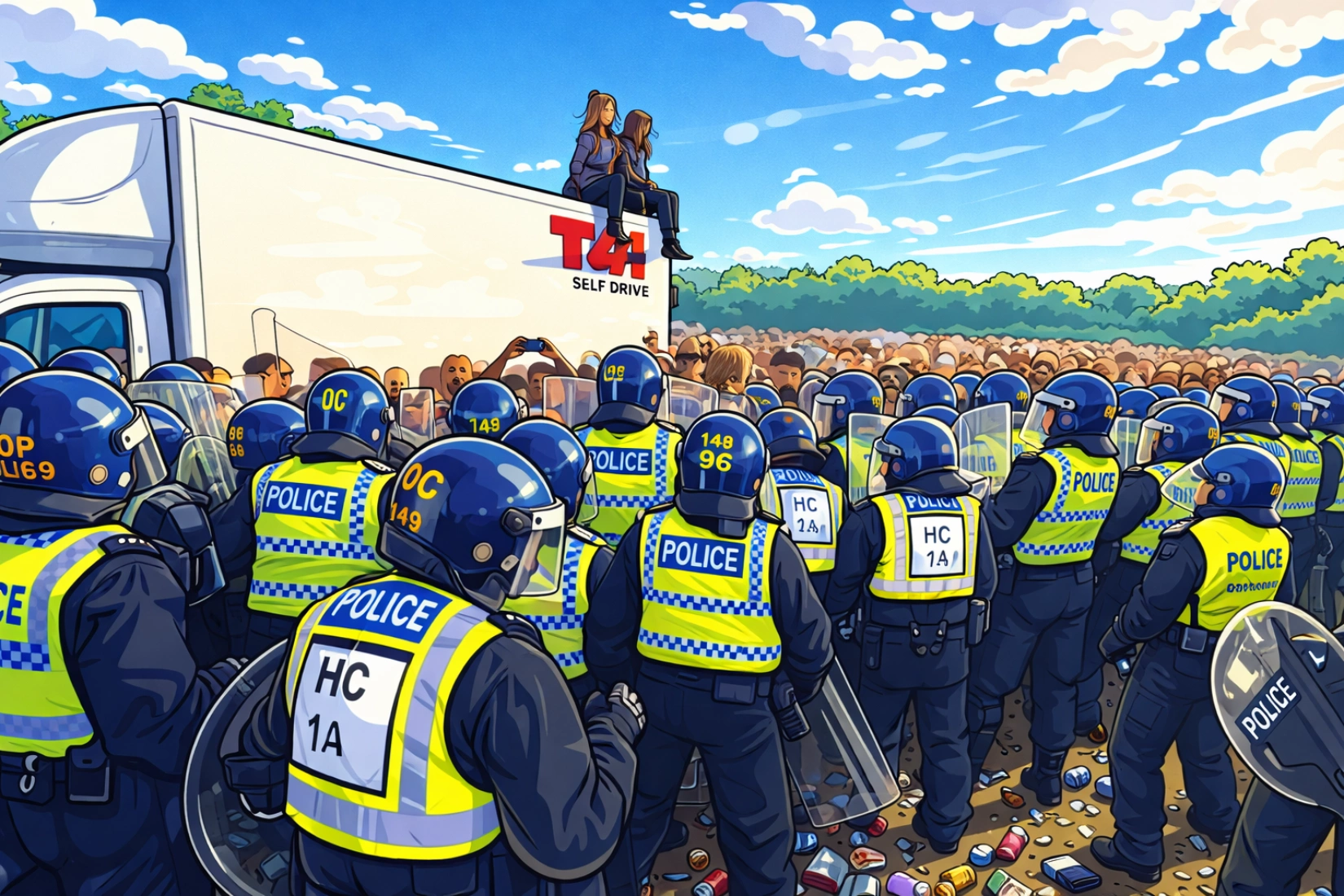
The Description of events in Dorset
An evening that commenced as a covert music festival in the undulating hills of East Lulworth transformed into a tumultuous confrontation: law enforcement clad in complete riot attire, a multitude of adolescents and young adults, and a barrage of “projectiles” launched at the authorities.
This is something that resembles more of a cinematic action screenplay than a customary Sunday in the countryside of England – yet it is occurring, compelling us to confront difficult inquiries regarding youth culture, public safety, and the responsibilities of the authorities.
Riot police pelted with bottles and cans as they shut down a huge illegal Easter rave with 2,000 revellers in a quiet Dorset village – just up the road from me, this.
— Leanne (@LeanneSpurs) April 6, 2026
The EggTek party in East Lulworth blasted trance music until 5 a.m., waking residents five miles away and… https://t.co/ByMHmLOUtx pic.twitter.com/WTfJlc5rAv
What Factors Contribute to the Continuous Emergence of “Unauthorized” Raves?
For numerous youths, the appeal extends beyond the music; it encompasses the feeling of being part of something beyond the conventional. The “unauthorized” label imparts an element of defiance, a sense of insubordination that is challenging to duplicate in a ticketed establishment with a security personnel at the entrance.
Licensing Obstacles
Judicial establishments are governed by stringent noise restrictions, occupancy limitations, and licensing costs. In numerous areas, particularly in rural locales, the closest authorized establishment may be several miles distant. When the formal entrances are shut, the clandestine portal swings ajar.
Social Media Enhances the Catalyst
An individual Instagram story or TikTok video can transform an obscure location into a temporary hotspot for hundreds in a matter of hours. The outcome? An audience that expands significantly beyond what the initial planners envisioned – in this instance, approximately 2,000 individuals.
Law enforcement personnel arrived in disturbance control equipment as they faced a gathering that had already become antagonistic. “Missiles,” as characterized in police documents, refer to bottles, cans, and various other solid items, that were being projected towards them. When a police officer’s life is endangered, the utilization of safety gear is warranted.
The Public Safety Perspective
An unlawful gathering of this magnitude presents numerous hazards: uncontrolled audio levels, fire threats, substance abuse, and the significant likelihood of a crowd surge. The law enforcement agency has an obligation to safeguard the adjacent community – the local agricultural properties, fauna, and households that did not consent to a late-night celebration.
Interpretation versus Actuality
Critics argue that the presence of riot equipment heightens anxiety. That is a valid concern; however, the truth is that law enforcement equipment is intended to ensure the safety of officers when circumstances escalate rapidly. The inquiry ought to be why the circumstances declined initially, rather than whether the equipment was on the officers.
Aggression is Not Unavoidable – It’s a Manifestation
When an assemblage perceives itself challenged by authority, the inclination to “resist” may materialize as hurling items. This is not an impulsive eruption; it represents a manifestation of profound skepticism between juvenile subcultures and law enforcement organizations.
Absence of Communication: Numerous events are arranged without any interaction with local authorities or law enforcement, resulting in a “us versus. “them” ethos.
Anxiety Regarding Repressive Measures: Speculations of severe penalties or detentions may lead individuals to perceive law enforcement as an adversary instead of an impartial entity.
Alcohol and Narcotics: Compounds can diminish reservations and elevate hostility, transforming a distressed audience into a missile-throwing throng.

