
Latest On AidenPromotions


SAP Weighs Eliminating Up to 10,000 Roles Amid Sweeping Artificial Intelligence Pivot


German enterprise software powerhouse SAP is reportedly evaluating plans to eliminate as many as 10,000 positions across its global operations as it accelerates a strategic pivot toward artificial intelligence. According to recent reporting from Bloomberg News, leadership is considering this major headcount reduction to streamline operations and ensure the organization is structurally equipped to capitalize on rapidly evolving AI technologies.
Should executives proceed with the plan, it would represent the second massive labor overhaul in just two years for Germany’s most valuable publicly traded company. Back in early 2024, SAP initiated a broad corporate reorganization that originally placed 8,000 jobs on the chopping block—a target that leadership eventually expanded to encompass between 9,000 and 10,000 roles.
People familiar with the internal deliberations suggest the newly proposed restructuring could impact approximately 9% of SAP’s worldwide personnel. As of the end of October, the firm employed a total global workforce of 113,076 people. Nevertheless, insiders caution that the final tally of redundancies remains fluid and is subject to adjustment pending mandatory negotiations and consultations with labor union representatives.
The potential shakeup reflects mounting turbulence across the international software industry, where the rapid advancement of artificial intelligence is actively reshaping market valuations. Financial analysts and investors have grown increasingly anxious that autonomous AI agents and sophisticated generative models could soon render traditional human-led functions obsolete—particularly in core areas such as software coding, data analytics, and automated workflow management.
Established in 1972, SAP built its reputation as a cornerstone of enterprise resource planning, providing comprehensive digital infrastructure that enables corporations to coordinate finance, human resources, procurement, and supply chain logistics. To defend its market share against emerging technological disruptors, the company has aggressively rolled out proprietary artificial intelligence tools, highlighted by its Business AI suite and its digital assistant platform, Joule, signaling a decisive shift toward an automated future.
Business AM
Arsenal and Champions League-Winning Manager Renee Slegers Separate Following Difficult Campaign Start

In an unexpected development within women's football, Arsenal have officially separated from head coach Renee Slegers following an underwhelming opening stretch to their domestic campaign. Despite guiding the North London outfit to European glory in the UEFA Women's Champions League just last year, the Dutch tactician stepped down from her role on Friday under what the club formally characterized as a "mutual consent" agreement.
The sudden departure comes amid growing frustration over the team's faltering domestic form. Even after bolstering their roster with several high-profile acquisitions during the summer transfer window, the Gunners have struggled to find consistency on the pitch. They currently languish in sixth place in the Women's Super League standings, having collected a modest 15 points across their opening 11 fixtures. That sluggish return leaves them trailing runaway league leaders Chelsea by a daunting 12-point margin, severely jeopardizing their title ambitions before the season has even reached its halfway mark.
In the immediate aftermath of Slegers' exit, Arsenal have turned to internal leadership to steady the ship. Assistant coach Melissa Clarke-Reed has been handed the managerial reins on an interim basis, tasked with revitalizing a talented squad that features German internationals Lisa Baum, Selina Cerci, and Anneke Borbe.
Reflecting on the managerial change, Clare Wheatley, Arsenal’s director of women’s football, acknowledged the gravity of the move, describing it as an "extremely difficult decision" for the organization. Wheatley paid tribute to the 37-year-old coach, emphasizing that Slegers had left "a significant and lasting contribution to the history" of the club during her tenure.
Slegers' journey at the helm of the Gunners began in October 2024, when she originally stepped into the dugout as a caretaker manager. Her impressive early work during that transitional period convinced the club's hierarchy to hand her the permanent position just three months later, a decision that ultimately culminated in their historic European triumph before this season's domestic downturn brought her chapter in North London to a close.
Leave a Comment
You must be logged in to post a comment.
November 27, 2026

Healthcare authorities across England are sounding the alarm over a rapid escalation in severe influenza cases, urging vulnerable citizens to secure their seasonal vaccinations without delay. Recent surveillance data published by the UK Health Security Agency (UKHSA) reveals that hospital admissions linked to the virus have jumped by nearly 80% within a single week. This steep upward trajectory marks the highest level of seasonal flu hospitalizations recorded at this point in the calendar since prior to the Covid-19 pandemic.
Despite the mounting pressure on medical facilities, immunization rates among the nation's most susceptible demographics remain noticeably behind historical averages. Currently, fewer than 68% of adults aged 65 and older have received their annual flu shot, falling short of the typical uptake expected by late November. For older individuals and those managing chronic illnesses, contracting influenza carries the risk of life-threatening complications.
Addressing delegates at the NHS Alliance autumn conference, the outgoing chief executive of NHS England, Sir Jim Mackey, highlighted the growing strain on hospital wards. He noted that certain healthcare trusts have already reinstated mandatory mask-wearing protocols to curb the transmission of respiratory infections. Recounting a recent visit to a medical facility, Sir Jim admitted it felt like "a bit of a shock" to be asked to put on a face covering for the first time in several years. He warned that inpatient bed occupancy for flu already surpasses last year's figures, even as the health service braces for the onset of what he described as a "horrible spike" in infections.
The immunization gap is even more pronounced among younger individuals living with underlying health vulnerabilities. Figures from the UKHSA indicate that roughly 9.5 million people under the age of 65 qualify for a free jab due to clinical risk factors, which include chronic respiratory illnesses, diabetes, and liver or kidney conditions. However, as of 22 November, just 34% of this cohort had come forward for vaccination. Consequently, nearly seven million high-risk residents remain exposed to the virus as winter sets in.
Beyond the immediate threat of viral transmission, Sir Jim used his platform to strongly criticize the widespread practice of treating patients in hospital hallways, stating that "corridor care" has become deeply entrenched within certain areas of the health service. Emphasizing both clinical safety and basic human dignity, he remarked that no one would wish such conditions upon their own parents, aunts, or uncles, and insisted that leadership must urgently take decisive action to eradicate the practice.
Offering scientific context on the outbreak, Suzanna McDonald, head of the UKHSA's influenza programme, identified the H1N1 strain as the primary driver behind the current wave of infections. Speaking during an appearance on BBC Radio 4's Today programme, she explained that this particular variant appears to have undergone slightly more genetic changes than experts typically anticipate at this stage of the winter season. Nevertheless, McDonald offered reassurance regarding the efficacy of current immunizations, pointing out that during the previous winter—when a similarly mutated strain circulated—the seasonal vaccine still delivered strong, reliable protection against severe illness.
Leave a Comment
You must be logged in to post a comment.
Apple Pulls Chinese AI Companion App ‘Talkie’ Worldwide Over Child Safety Concerns

Apple has removed Talkie, a popular artificial intelligence chatbot application developed by Shanghai-based AI firm MiniMax, from its global App Store. According to a report by Reuters, the takedown comes in the wake of disturbing media findings that the app’s virtual characters engaged in sexually inappropriate exchanges with children.
First launched in 2023, Talkie—which also operates in China under the name Xingye—enables users to converse with customizable, AI-generated personas, many of which are specifically designed for romantic roleplay and emotional companionship.
Investigation Exposes Flawed Age Verification
The crackdown was triggered by a joint investigation from ABC News and the Bureau of Investigative Journalism, published on Wednesday. Reporters uncovered that AI characters on the platform had sent sexually explicit and abusive messages to underage users.
While Talkie carries an 18+ age rating on both the Apple App Store and Google Play Store—and officially prohibits sign-ups from users under 14 or 16 depending on regional laws—critics and researchers have pointed to severe loopholes in its onboarding process. Currently, the app relies on self-reported birthdates without rigorous verification checks, making it easy for minors to bypass restrictions.
The Rise and Risk of AI Companions
Unlike standard productivity-focused AI assistants such as OpenAI's ChatGPT or Google's Gemini, AI companion platforms are engineered to foster deep, ongoing emotional bonds through continuous, personalized storylines. As these apps gain traction, tech giants and regulators are facing mounting pressure to address the psychological and safety risks posed to younger audiences.
A Major Blow to MiniMax
The removal represents a significant commercial setback for MiniMax. Together, Talkie and its domestic counterpart Xingye serve as critical financial engines for the company, having generated more than 60% of MiniMax's total revenue in 2024 (though the firm stopped breaking out individual chatbot earnings earlier this year).
Prior to the App Store ban, Talkie boasted a massive global footprint, drawing roughly 11 million monthly active users across its mobile app and web platform as of October 2026, according to data from Chinese research firm Unique.
Leave a Comment
You must be logged in to post a comment.
Millions of UK Homeowners Face £1,200 Annual Mortgage Hike, Bank of England Warns

New Financial Stability Report reveals the median monthly cost of remortgaging has doubled since July as geopolitical tensions drive up borrowing rates.
Roughly 6.5 million British homeowners are bracing for steeper mortgage bills over the next three years as their existing fixed-rate deals expire, according to new projections from the Bank of England.
Released on Thursday by the Bank’s Financial Policy Committee (FPC), the November Financial Stability Report revises upward its July estimates by half a million households. Borrowers rolling off fixed deals now face a median monthly jump of approximately £100—an extra £1,200 a year—representing double the financial hit forecast just four months ago.
Geopolitical Pressures Fuel Rate Hikes
The sharp upward revision stems from shifting interest rate expectations triggered by escalating conflict in the Middle East, which has pushed global energy prices higher. In response to mounting inflationary pressures, the Bank’s Monetary Policy Committee raised the base Bank Rate earlier this month from 3.75% to 4%—marking its first rate increase since August 2023.
This shift has quickly filtered into the mortgage market:
- Two-year fixed rates have climbed to 5.39% for borrowers with a 75% loan-to-value (LTV) ratio (up 0.47 percentage points since July) and 5.60% at 90% LTV (up 0.28 points).
- Five-year fixed rates currently average 5.19% at 75% LTV and 5.38% at 90% LTV.
A Tale of Two Borrower Groups
Out of roughly nine million owner-occupier mortgages nationwide, around seven million are scheduled to refinance between June 2026 and December 2029. While 6.5 million of these households will see their payments climb, only an estimated 350,000 will enjoy a reduction.
Despite the stark headline numbers, the Bank notes that most borrowers have already weathered an initial rate shock. Because the vast majority have refinanced at least once since rates began climbing in 2022, they are transitioning from one elevated rate to another. Consequently, today's typical £100 monthly increase is roughly half the £200 surge borrowers endured during 2023 and 2024.
The most acute shock awaits a smaller cohort: just over one million households still locked into ultra-low rates below 3%. With their pre-2022 deals set to expire by the end of 2027, these borrowers face a far steeper payment cliff than the national average.
Household Budgets Stretched to Post-2008 Lows
As mortgage repayments consume a larger slice of disposable income over the next three years, household financial cushions are thinning. The Bank warns that if elevated energy prices persist, the typical family will have less money left over after covering housing, food, and energy bills than at any time since the 2008–09 global financial crisis.
Even so, British households remain better insulated than they were at the nadir of the 2008 crash; returning to those stress levels would require borrowing costs to surge by another 1.5 percentage points beyond current market projections.
For now, most homeowners are expected to absorb the higher costs by dipping into savings and trimming discretionary spending. However, financial brokers warn that clients who comfortably managed their last remortgage may find the math far less forgiving this time around.
Low-Income Strain vs. Low Arrears
Lower-income families and renters—who already spend a disproportionate share of their earnings on groceries and utilities—have the least margin for error. Intelligence gathered by the Bank’s regional Agents points to rising financial distress among lower-income borrowers, accompanied by an uptick in debt-relief arrangements.
Broader polling from NMG Consulting echoes this squeeze, with nearly 30% of UK households reporting financial pressure—a figure roughly 10 percentage points higher than in 2021, though largely unchanged since 2022.
Interestingly, this budget tightening has not yet translated into widespread defaults. Mortgage arrears remain near historical norms, leading the FPC to classify household debt risks as "contained." Still, the Bank cautioned that arrears figures are a lagging indicator, urging mortgage brokers to proactively review clients whose deals are nearing expiration before tight budgets turn into missed payments.
Mixed Signals for First-Time Buyers
For aspiring homeowners, the market presents a complex trade-off between borrowing power and affordability. Following regulatory changes, lenders have greater leeway to issue loans at 4.5 times a buyer's income or higher—allowing an earner on £50,000 to borrow £225,000 or more. Roughly one in seven new mortgages now fall into this high-multiple bracket, with first-time buyers (FTBs) accounting for over half of them, though rising interest rates are beginning to cool this demand.
Ultimately, looser lending rules do not solve the biggest hurdle for new buyers: raising a deposit. Earlier Bank research revealed that nearly 80% of prospective FTBs cannot afford a 5% down payment on a typical starter home in their region. A cooling property market could offer some relief, however, as UK house prices dipped month-on-month in July and August before flattening out in September.
Leave a Comment
You must be logged in to post a comment.
Spain’s De Cos Chosen to Lead ECB as Europe Faces Housing and Political Pressures

European leaders have chosen Pablo Hernández de Cos, Spain’s former central bank governor, to succeed Christine Lagarde as president of the European Central Bank. The decision signals a preference for continuity at the eurozone’s most powerful financial institution as Europe confronts inflation, high borrowing costs and concerns over government debt.
Eurozone member states agreed on Thursday to recommend De Cos for the ECB’s top job, according to European Council President António Costa. The appointment must still complete the formal approval process, which is expected to be finalized in mid-December. De Cos is set to take office after Lagarde steps down in February.
The choice makes De Cos the first Spaniard to lead the ECB, one of the world’s most influential central banks. He previously served as governor of the Bank of Spain from 2018 to 2024 and was a member of the ECB’s Governing Council during that period. He currently works at the Bank for International Settlements, often described as the “central bank for central banks.”
A steady hand at the ECB
De Cos is widely viewed as a cautious, orthodox economist and a consensus builder. His selection is expected to reassure markets and eurozone governments that the bank will maintain a steady approach to monetary policy as it balances inflation risks against slowing growth and rising public debt.
The ECB is facing a difficult economic environment. European leaders cited inflation pressures linked to the war in Iran, alongside worries about high government debt and borrowing costs across the continent. The appointment comes at a time when even modest changes in interest rates can affect mortgages, business investment and public finances throughout the eurozone.
De Cos’s background may help him navigate those pressures. As a former national central bank chief and ECB policymaker, he brings direct experience with eurozone monetary decisions, banking supervision and financial stability. His reputation for technical competence and political restraint is likely to be central to his leadership style.
Spain’s political backdrop
The ECB appointment arrives just days before Spain’s snap general election on Sunday, which could unseat Prime Minister Pedro Sánchez. Housing affordability has become one of the most important issues in the campaign, with rising rents and home prices putting pressure on households and shaping voter sentiment.
Spain’s housing crisis has intensified over the past decade. Between 2015 and 2025, average home prices rose by 80 percent, while rents increased by 87 percent, according to reporting on the country’s election. Those increases have made housing a central test of the government’s ability to protect ordinary voters from the rising cost of living.
Sánchez has sought to make housing a defining election issue, framing it as both a policy challenge and a political opportunity. But the issue also exposes vulnerabilities for his government, as many voters blame rising rents, limited supply and speculative investment for making homeownership and stable rental housing harder to afford.
A changing political landscape
Spain’s election is taking place amid a broader shift in European politics. Concerns over immigration, economic insecurity and the cost of living have strengthened right-leaning and far-right parties in several countries, including Spain, where the far right has not governed since the Franco era.
The election could reshape Spain’s governing coalition and influence the country’s approach to housing, immigration, public spending and relations with the European Union. It may also affect the political environment surrounding De Cos’s appointment, even though the ECB president is expected to operate independently of national governments.
De Cos’s selection has received support across Spain’s political divide. He was originally chosen to lead the Bank of Spain by the conservative Popular Party in 2018, while later receiving backing from Sánchez’s Socialist Party for the ECB presidency. That unusual cross-party support has reinforced his image as a technocrat capable of working above partisan conflict.
What comes next
For now, De Cos’s immediate task will be to guide the ECB through a period of economic uncertainty without triggering a sharp policy shift. Investors and European governments will watch closely for signs of how he approaches interest rates, inflation control and support for financially strained member states.
In Spain, voters will head to the polls with housing costs, immigration and the future of Sánchez’s government at the center of the national debate. Together, the ECB appointment and the election highlight how economic policy and domestic politics are becoming increasingly intertwined across Europe.
Leave a Comment
You must be logged in to post a comment.
November 27, 2026

French cinema star Gérard Depardieu will stand trial over allegations that he raped actress Charlotte Arnould at his Paris home in 2018, after a Paris appeals court rejected his attempt to stop the case from proceeding.
The Paris Court of Appeal on Thursday upheld an earlier order sending the 77-year-old actor to criminal trial for alleged rape and sexual assault on August 7, 2018. The court, however, dismissed a second alleged rape said to have occurred six days later, on August 13.
Arnould, who was 22 at the time, accused Depardieu of raping her twice in 2018. Her allegations led to a lengthy investigation and a legal battle over whether the case should reach trial.pbs+2
Depardieu’s lawyers had appealed against the investigating judge’s decision to send him to trial, seeking to have the proceedings dropped. The appeals court’s ruling means the case will now proceed, although the actor may still appeal to France’s highest court, the Cour de Cassation.
The decision comes less than two weeks after Depardieu withdrew his appeal against a separate sexual-assault conviction. He had earlier apologized to people who may have suffered because of his actions.
Depardieu, one of France’s best-known actors, has repeatedly denied wrongdoing in the rape case. The upcoming trial will place renewed scrutiny on one of French cinema’s most prominent figures amid wider debates over sexual misconduct in the country’s film industry.
Leave a Comment
You must be logged in to post a comment.
Zelenskyy Slams Trump Over Putin ‘Friend’ Remark, Warns of Major Russian Strikes

Ukrainian President Volodymyr Zelenskyy has sharply criticized U.S. President Donald Trump for calling Russian President Vladimir Putin a “friend,” saying the United States is not applying enough pressure on Moscow in peace negotiations. He also warned that Russia may be preparing another major attack on Ukraine’s energy infrastructure.
Zelenskyy’s criticism
In an interview with the BBC, Zelenskyy said it was “strange” for Trump to post a photograph embracing Putin and describe him as a friend. He argued that such language risks making Moscow feel it faces too little pressure, even as Russian attacks continue against Ukrainian cities and civilians.
Zelenskyy went further by comparing Trump’s description of Putin to calling Adolf Hitler a friend during the Second World War. He called Putin “an aggressor” and “a killer,” stressing that Ukraine needs Washington to act as a firm ally rather than appear neutral toward Russia.
Pressure on peace talks
The Ukrainian leader said the United States has been “too focused on the Middle East” and is not pushing Russia hard enough in the U.S.-backed peace process. He said the latest round of talks in Abu Dhabi produced no visible breakthrough, adding that the more details emerged, the more problems appeared.
Zelenskyy argued that because Russia is the aggressor, the United States should use greater diplomatic and economic pressure to force Moscow to change course. He said Ukraine needs meaningful security guarantees and stronger support to reach a peace agreement that does not leave the country vulnerable.
Warning of new strikes
Zelenskyy also warned that Russian forces are completing preparations for a large-scale attack on Ukraine’s power grid, logistics networks and critical services. His warning came after overnight Russian missile and drone strikes left crews working to restore electricity in six regions.
Ukraine has urged Western partners to speed up deliveries of air-defence systems and interceptors, particularly for Patriot missile batteries. Zelenskyy said shortages of these weapons are costing lives as Russia intensifies ballistic-missile attacks.
A widening rift
Trump has defended his relationship with Putin, saying their talks could help bring peace, while declining to say whether Putin is a friend to the United States. The remarks have added to uncertainty around Washington’s mediation efforts, especially as Russian strikes continue and Kyiv fears being pressured into an unfavorable settlement.
Zelenskyy’s comments mark one of his strongest public rebukes of the U.S. president, reflecting growing frustration in Kyiv over the pace of negotiations, air-defence shortages and the escalating human cost of Russia’s invasion.
Leave a Comment
You must be logged in to post a comment.
I Used AI Versions of Myself to Make YouTube Shorts; Here’s What Happened

I expected my AI clones to save me a few hours a week. Instead, they changed how I created, tested, and earned from YouTube Shorts—while also teaching me exactly where the line is between “AI-assisted creator” and “generic content machine.”
When YouTube began rolling out a Shorts feature that lets eligible creators generate a photorealistic digital version of themselves from a live selfie and voice samples, I decided to run a real experiment.
I made several AI versions of myself: a fast-talking “explainer” version, a calm storytelling version, and a more energetic version for product-style hooks.
The result was not a fully automated money-printing channel. It was a repeatable production system that helped me publish more consistently, test ideas faster, and build toward monetization without losing the personal point of view that makes a channel worth watching.
Why I Tried It
I had a familiar creator problem: I could generate ideas quickly, but filming, retakes, lighting, and editing made publishing daily feel impossible. Shorts reward volume and iteration, yet I did not want to become a faceless channel posting generic clips with no recognizable perspective.
YouTube’s avatar tool is designed for exactly that middle ground. After a one-time setup capturing your face and voice, you can prompt the system to create short clips of your avatar; the generated segments are limited to eight seconds, so a typical Short still requires combining several clips, a script, captions, sound design, and editing.
My goal was simple: use the AI version of me to handle the repetitive on-camera work, while I supplied the ideas, research, opinions, and final edit.
How I Built My AI Versions
I started with one “base” version of myself rather than trying to create a dozen different personalities. I recorded a clean selfie video in even lighting, spoke naturally through the voice-capture process, and avoided exaggerated expressions that would make the clone look stiff or uncanny.
Then I created three practical variations:
| Version | Best use | What I changed |
|---|---|---|
| The Explainer | “Here’s what most people get wrong about…” | Direct eye contact, concise delivery, neutral background |
| The Storyteller | Personal lessons and behind-the-scenes moments | Slower pacing, more expressive gestures |
| The Hook Machine | First three seconds of Shorts | Higher energy, close framing, punchier phrasing |
The important part was not making the avatar look perfect. It was making it sound like me—with my actual opinions, phrasing, and point of view.
What Happened in the First Month
In the first week, I published five Shorts. Two performed poorly, two did okay, and one clearly outperformed the rest. That is not a viral miracle, but it was enough data to change my workflow.
The winning Short followed a formula I now use repeatedly:
- Open with a specific, personal claim.
- Show the AI version of me explaining the problem in under five seconds.
- Cut to screen recording, b-roll, or a simple visual demonstration.
- Return to the avatar for a clear takeaway.
- End with a question that invites comments.
The biggest surprise was that viewers did not reject the AI version outright. What they rejected was content that felt empty. When the Short taught something useful, shared a real observation, or made them laugh, the avatar felt like a production tool. When I used it to recycle generic advice, engagement dropped immediately.
That matches YouTube’s current monetization approach: AI-assisted videos can remain eligible, but content that looks mass-produced from generic templates and lacks the creator’s original insight is at risk. YouTube specifically treats original perspective, research, and authentic value as the deciding factors.mashable+1
The Results I Can Defend
I will not pretend I woke up to a seven-figure channel. But the experiment produced a meaningful, measurable outcome: my publishing cadence increased, my best-performing format became clearer, and I began building a library of Shorts that could compound over time.
The realistic upside is supported by creators who have used AI workflows recently. One creator documented reaching 722,857 views on a seven-day Shorts challenge, after previously building a Shorts channel that passed 50 million views; the lesson was not “AI makes you viral,” but that a focused format, fast iteration, and a strong hook can produce outsized reach.
Other creators have used AI clones to reduce production time and pursue more commercial opportunities. Dutch YouTuber Jordi van den Bussche, known as Kwebbelkop, began replacing much of his on-camera workload with an AI version of himself after burnout made constant filming unsustainable. His case shows the real value: not replacing a creator, but giving a creator more capacity to make decisions, develop ideas, and run the business.
For me, the successful outcome was this: I went from sporadic uploads to a predictable Shorts system, identified a repeatable hook format, and created enough volume to learn what my audience actually wanted.
What Worked Best
- One idea, many executions. I turned one strong insight into three or four different Shorts: a story version, a contrarian version, a list version, and a “mistake to avoid” version.
- Strong first three seconds. The avatar made it easy to test different openings without reshooting myself every time.
- Real expertise on screen. My best clips included a specific example, a mistake I made, or a practical takeaway—not just a generic motivational statement.
- Human editing after generation. I cut awkward pauses, fixed captions, added context, and made sure the final Short had a reason to exist.
- Disclosure and transparency. YouTube’s avatar-generated Shorts include visible disclosures and digital markers identifying the content as AI-generated, including watermarking, SynthID, and C2PA labels.
What Did Not Work
My worst performing Shorts had one thing in common: they sounded like content made for an algorithm rather than a person.
I tried a few “post three times a day with trending topics” experiments. The views were inconsistent, the comments were shallow, and the videos did not build a recognizable channel identity.
I also learned not to let the AI version deliver financial, medical, or highly technical advice without verification and clear framing; YouTube has specifically identified AI personas giving health or finance advice as a category that cannot earn ad revenue.
The other mistake was relying on the avatar for emotional storytelling. AI can approximate delivery, but it cannot replace lived experience. When I shared a real lesson from my own work, retention improved. When I asked it to pretend I had an experience I did not have, the content felt hollow.
How I Would Do It Again
If I started today, I would use this process:
- Choose one narrow topic where I have genuine experience.
- Create one AI version of myself, not a cast of fake personalities.
- Film a batch of real ideas, stories, and opinions first.
- Use the avatar to produce multiple hooks and versions of each idea.
- Edit every Short as if a skeptical viewer is deciding in two seconds whether to keep watching.
- Track retention, comments, shares, and subscribers—not just views.
- Keep the human perspective central in every video.
The Honest Takeaway
Using AI versions of myself did not make YouTube easy. It made the difficult parts easier: filming variations, testing hooks, maintaining a schedule, and turning one idea into several Shorts.
The creators seeing real success are not simply uploading automated clips. They are using AI to amplify a clear point of view, publish more often, and free up time for the work that actually differentiates them.
YouTube’s own rules reinforce that distinction: AI-generated content can qualify for monetization, but generic, mass-produced material without original insight does not.
My AI versions became useful because I treated them as collaborators, not replacements. The moment I let them carry the ideas, the results suffered. The moment I gave them my actual perspective, the channel started to feel like mine again—and that is when the Shorts began to work.
Leave a Comment
You must be logged in to post a comment.
Business Articles
SAP Weighs Eliminating Up to 10,000 Roles Amid Sweeping Artificial Intelligence Pivot
German enterprise software powerhouse SAP is reportedly evaluating plans to eliminate as many as 10,000 positions across its global operations as it accelerates a strategic pivot toward artificial intelligence. According to recent reporting from Bloomberg News, leadership is considering this major headcount reduction to streamline operations and ensure the organization is structurally equipped to capitalize on rapidly evolving AI technologies.
Should executives proceed with the plan, it would represent the second massive labor overhaul in just two years for Germany’s most valuable publicly traded company. Back in early 2024, SAP initiated a broad corporate reorganization that originally placed 8,000 jobs on the chopping block—a target that leadership eventually expanded to encompass between 9,000 and 10,000 roles.
People familiar with the internal deliberations suggest the newly proposed restructuring could impact approximately 9% of SAP’s worldwide personnel. As of the end of October, the firm employed a total global workforce of 113,076 people. Nevertheless, insiders caution that the final tally of redundancies remains fluid and is subject to adjustment pending mandatory negotiations and consultations with labor union representatives.
The potential shakeup reflects mounting turbulence across the international software industry, where the rapid advancement of artificial intelligence is actively reshaping market valuations. Financial analysts and investors have grown increasingly anxious that autonomous AI agents and sophisticated generative models could soon render traditional human-led functions obsolete—particularly in core areas such as software coding, data analytics, and automated workflow management.
Established in 1972, SAP built its reputation as a cornerstone of enterprise resource planning, providing comprehensive digital infrastructure that enables corporations to coordinate finance, human resources, procurement, and supply chain logistics. To defend its market share against emerging technological disruptors, the company has aggressively rolled out proprietary artificial intelligence tools, highlighted by its Business AI suite and its digital assistant platform, Joule, signaling a decisive shift toward an automated future.
Business AM
Leave a Comment
You must be logged in to post a comment.
I Used AI Versions of Myself to Make YouTube Shorts; Here’s What Happened
I expected my AI clones to save me a few hours a week. Instead, they changed how I created, tested, and earned from YouTube Shorts—while also teaching me exactly where the line is between “AI-assisted creator” and “generic content machine.”
When YouTube began rolling out a Shorts feature that lets eligible creators generate a photorealistic digital version of themselves from a live selfie and voice samples, I decided to run a real experiment.
I made several AI versions of myself: a fast-talking “explainer” version, a calm storytelling version, and a more energetic version for product-style hooks.
The result was not a fully automated money-printing channel. It was a repeatable production system that helped me publish more consistently, test ideas faster, and build toward monetization without losing the personal point of view that makes a channel worth watching.
Why I Tried It
I had a familiar creator problem: I could generate ideas quickly, but filming, retakes, lighting, and editing made publishing daily feel impossible. Shorts reward volume and iteration, yet I did not want to become a faceless channel posting generic clips with no recognizable perspective.
YouTube’s avatar tool is designed for exactly that middle ground. After a one-time setup capturing your face and voice, you can prompt the system to create short clips of your avatar; the generated segments are limited to eight seconds, so a typical Short still requires combining several clips, a script, captions, sound design, and editing.
My goal was simple: use the AI version of me to handle the repetitive on-camera work, while I supplied the ideas, research, opinions, and final edit.
How I Built My AI Versions
I started with one “base” version of myself rather than trying to create a dozen different personalities. I recorded a clean selfie video in even lighting, spoke naturally through the voice-capture process, and avoided exaggerated expressions that would make the clone look stiff or uncanny.
Then I created three practical variations:
| Version | Best use | What I changed |
|---|---|---|
| The Explainer | “Here’s what most people get wrong about…” | Direct eye contact, concise delivery, neutral background |
| The Storyteller | Personal lessons and behind-the-scenes moments | Slower pacing, more expressive gestures |
| The Hook Machine | First three seconds of Shorts | Higher energy, close framing, punchier phrasing |
The important part was not making the avatar look perfect. It was making it sound like me—with my actual opinions, phrasing, and point of view.
What Happened in the First Month
In the first week, I published five Shorts. Two performed poorly, two did okay, and one clearly outperformed the rest. That is not a viral miracle, but it was enough data to change my workflow.
The winning Short followed a formula I now use repeatedly:
- Open with a specific, personal claim.
- Show the AI version of me explaining the problem in under five seconds.
- Cut to screen recording, b-roll, or a simple visual demonstration.
- Return to the avatar for a clear takeaway.
- End with a question that invites comments.
The biggest surprise was that viewers did not reject the AI version outright. What they rejected was content that felt empty. When the Short taught something useful, shared a real observation, or made them laugh, the avatar felt like a production tool. When I used it to recycle generic advice, engagement dropped immediately.
That matches YouTube’s current monetization approach: AI-assisted videos can remain eligible, but content that looks mass-produced from generic templates and lacks the creator’s original insight is at risk. YouTube specifically treats original perspective, research, and authentic value as the deciding factors.mashable+1
The Results I Can Defend
I will not pretend I woke up to a seven-figure channel. But the experiment produced a meaningful, measurable outcome: my publishing cadence increased, my best-performing format became clearer, and I began building a library of Shorts that could compound over time.
The realistic upside is supported by creators who have used AI workflows recently. One creator documented reaching 722,857 views on a seven-day Shorts challenge, after previously building a Shorts channel that passed 50 million views; the lesson was not “AI makes you viral,” but that a focused format, fast iteration, and a strong hook can produce outsized reach.
Other creators have used AI clones to reduce production time and pursue more commercial opportunities. Dutch YouTuber Jordi van den Bussche, known as Kwebbelkop, began replacing much of his on-camera workload with an AI version of himself after burnout made constant filming unsustainable. His case shows the real value: not replacing a creator, but giving a creator more capacity to make decisions, develop ideas, and run the business.
For me, the successful outcome was this: I went from sporadic uploads to a predictable Shorts system, identified a repeatable hook format, and created enough volume to learn what my audience actually wanted.
What Worked Best
- One idea, many executions. I turned one strong insight into three or four different Shorts: a story version, a contrarian version, a list version, and a “mistake to avoid” version.
- Strong first three seconds. The avatar made it easy to test different openings without reshooting myself every time.
- Real expertise on screen. My best clips included a specific example, a mistake I made, or a practical takeaway—not just a generic motivational statement.
- Human editing after generation. I cut awkward pauses, fixed captions, added context, and made sure the final Short had a reason to exist.
- Disclosure and transparency. YouTube’s avatar-generated Shorts include visible disclosures and digital markers identifying the content as AI-generated, including watermarking, SynthID, and C2PA labels.
What Did Not Work
My worst performing Shorts had one thing in common: they sounded like content made for an algorithm rather than a person.
I tried a few “post three times a day with trending topics” experiments. The views were inconsistent, the comments were shallow, and the videos did not build a recognizable channel identity.
I also learned not to let the AI version deliver financial, medical, or highly technical advice without verification and clear framing; YouTube has specifically identified AI personas giving health or finance advice as a category that cannot earn ad revenue.
The other mistake was relying on the avatar for emotional storytelling. AI can approximate delivery, but it cannot replace lived experience. When I shared a real lesson from my own work, retention improved. When I asked it to pretend I had an experience I did not have, the content felt hollow.
How I Would Do It Again
If I started today, I would use this process:
- Choose one narrow topic where I have genuine experience.
- Create one AI version of myself, not a cast of fake personalities.
- Film a batch of real ideas, stories, and opinions first.
- Use the avatar to produce multiple hooks and versions of each idea.
- Edit every Short as if a skeptical viewer is deciding in two seconds whether to keep watching.
- Track retention, comments, shares, and subscribers—not just views.
- Keep the human perspective central in every video.
The Honest Takeaway
Using AI versions of myself did not make YouTube easy. It made the difficult parts easier: filming variations, testing hooks, maintaining a schedule, and turning one idea into several Shorts.
The creators seeing real success are not simply uploading automated clips. They are using AI to amplify a clear point of view, publish more often, and free up time for the work that actually differentiates them.
YouTube’s own rules reinforce that distinction: AI-generated content can qualify for monetization, but generic, mass-produced material without original insight does not.
My AI versions became useful because I treated them as collaborators, not replacements. The moment I let them carry the ideas, the results suffered. The moment I gave them my actual perspective, the channel started to feel like mine again—and that is when the Shorts began to work.
Leave a Comment
You must be logged in to post a comment.
November 10, 2026

Can a Person in the USA Make Good Money From Filling Out Online Surveys?
Short answer: yes—but only as a modest side income, not as a dependable way to make “good money” or replace a job. For most people in the U.S., surveys produce roughly $50–$300 per month with consistent effort, while specialized research panels, interviews, and focus groups can occasionally pay much more.
What “Good Money” Really Means
Online surveys are legitimate because companies, universities, and market-research firms pay consumers for opinions that guide products, advertising, and policy decisions. However, the pay is usually low because the work requires no specialized skill, has a large supply of participants, and includes unpaid time spent qualifying for studies.
A realistic way to frame the opportunity is:
| Income level | Typical monthly result | What it can do |
|---|---|---|
| Casual user | $10–$50 | Covers small subscriptions, coffee, or a minor bill |
| Regular user | $50–$300 | Builds a small savings cushion or pays down debt faster |
| Strategic user using research panels | $250–$500+ | A meaningful side hustle, especially with interviews or focus groups |
| Full-time replacement | Rare and unreliable | Not a practical goal for most people |
Forbes reports that typical survey earnings are about $1–$5 per survey, with consistent users often making $50–$300 per month. CBS News similarly notes that a person taking three surveys daily on Survey Junkie may earn up to about $40 per month, while broader use of multiple platforms can produce a few hundred to a couple thousand dollars annually.
Why Surveys Pay So Little
The biggest limitation is the effective hourly rate. Many surveys pay only cents to a few dollars, and participants frequently spend time answering screening questions only to be disqualified before receiving meaningful compensation. Lifehacker found that many survey platforms pay far below the federal minimum wage—sometimes under $1 per hour—and that one user completed only 53 of 152 attempted surveys over about six weeks, earning just $26.17.
There are three structural reasons:
- Screening and disqualification: Demographic criteria can end a survey after several minutes, often with little or no payment.
- Unpaid search time: Finding available, qualifying surveys takes time that is not compensated.
- Low value per response: Standard consumer-opinion surveys are easy to complete, so the market does not need to pay much for them.
Where the Better Money Is
The higher-paying opportunities usually are not ordinary “click-through” surveys. They are research studies, product tests, professional consultations, telephone interviews, and focus groups that target a narrower audience. A 30-minute survey might pay $10–$20, while a 90-minute study may pay $100–$150; some specialized interviews can pay hundreds of dollars.
Examples of higher-value formats include:
- Focus groups: Often $50–$200, with some in-depth studies reaching $1,200 or more.
- Professional or expert surveys: A 15-minute Maven survey may pay $25–$50, depending on expertise.
- Academic research platforms: Prolific pays real cash rather than points or gift cards and requires researchers to pay at least $8 per hour, with $12 per hour recommended.prolific+1
- Long, niche studies: These may pay $50–$1,500, but eligibility is often restricted by profession, health status, income, location, or specialized experience.
Prolific is a useful example of the difference between ordinary survey sites and research platforms. It shows the reward and estimated time before a participant starts, pays through PayPal, and enforces a minimum participant rate of $8 per hour. That does not guarantee high earnings, but it makes the pay-per-time calculation more transparent than many points-based reward sites.
How to Earn More Strategically
A person in the U.S. can improve results by treating surveys like a low-paying but flexible micro-job rather than a passive income stream.
- Use several reputable platforms. More platforms means more invitations, though it also means more screening. Forbes specifically notes that joining multiple platforms increases earning opportunities.
- Prioritize pay per minute, not headline payout. A $1 survey that takes three minutes can beat a $5 survey that takes 30 minutes.
- Complete profile questionnaires carefully. Accurate demographics help match you with better-paying studies, but never provide sensitive data such as a Social Security number or bank login just to qualify.
- Focus on research panels and interviews. These have lower volume but much better compensation than standard surveys.
- Cash out early and often. Points can lose practical value if a site changes terms, closes, or makes redemption difficult.
- Track your time. If you earn $12 across three hours, that is $4 per hour—useful only if you value the flexibility more than the wage.
Scams and Privacy Risks
The survey industry includes legitimate companies, but it also attracts scams. The Better Business Bureau warns that if a site promises users will “get rich” from surveys, it is probably a scam.
Avoid any platform that:
- Charges an upfront “registration,” “activation,” or “training” fee.
- Promises unrealistic returns, such as hundreds of dollars daily for simple surveys.
- Requests a Social Security number, bank-password credentials, or payment to receive work.
- Has vague ownership information, no privacy policy, or poor redemption reviews.
- Pressures you to recruit other people rather than paying for actual research participation.
Reputable platforms generally pay through PayPal, direct deposit, or gift cards after a user reaches a payout threshold. Still, participants should limit the personal information they share and use a dedicated email address for survey sign-ups.
Taxes and Record-Keeping
Survey earnings are generally considered taxable income in the United States, even when paid in gift cards or through PayPal. Prolific explicitly tells participants that they are independent contractors and are responsible for determining whether their rewards must be reported to their tax authority.
Practical steps include:
- Keep a simple spreadsheet of date, platform, gross reward, and payout method.
- Save PayPal statements, gift-card confirmations, and 1099 forms if issued.
- Remember that receiving a gift card instead of cash does not automatically make the reward non-taxable.
- Consult a tax professional if survey income becomes substantial or if you receive confusing tax documents.
Who Should Try Surveys?
Online surveys make the most sense for people who have fragmented free time and modest income goals: students, caregivers, commuters, retirees, or anyone waiting between tasks. They require no investment, no interview, and little skill, which makes them accessible.finance.
They make less sense for someone who needs reliable income, wants at least minimum wage, or has marketable skills that could earn more through freelancing, tutoring, delivery work, virtual assistance, or part-time employment. Even favorable estimates put ordinary survey earnings in the low hundreds per month, not enough to cover typical U.S. living costs.
Review of the Article
Accuracy: The article presents a balanced view. It correctly distinguishes between low-paying consumer surveys and higher-paying research studies, interviews, and focus groups. The earnings ranges align with reporting from Forbes, CBS News, Lifehacker, and industry sources.
Strengths: It avoids exaggerated claims, explains why hourly pay is often poor, identifies realistic monthly earnings, and gives practical tactics for improving results. It also addresses scams, privacy, and taxes—three areas often omitted from promotional “make money online” content.
Limitations: Actual earnings vary substantially by demographics, location, availability, and persistence. A person with a sought-after professional background may receive more invitations to paid consultations, while another user may see mostly low-value surveys. The figures should therefore be treated as ranges, not guarantees.
Bottom line: A person in the USA can make some good extra money from surveys—especially by focusing on legitimate research panels and interviews—but surveys are best understood as a flexible supplemental-income tool, not a career or reliable full-time income source.
Leave a Comment
You must be logged in to post a comment.
Top 10 Business Automation Tools for 2026/27: In-Depth Reviews, Features, Pros, and Cons
Businesses are increasingly turning to automation software to reduce operating costs, improve productivity, manage customers, and eliminate repetitive administrative work.
In 2026, business automation is no longer limited to large corporations with dedicated IT departments. Small businesses, startups, online retailers, marketing agencies, and independent entrepreneurs are also using automation tools to handle tasks that once required several employees.
The latest generation of business automation platforms goes beyond connecting applications. Many now incorporate artificial intelligence (AI), intelligent workflow management, robotic process automation (RPA), and automated decision-making.
These capabilities allow companies to automate everything from customer inquiries and sales follow-ups to invoice processing, employee onboarding, inventory updates, and internal reporting.
However, not every automation platform is suitable for every organization. Some products are incredibly easy to use but become expensive as businesses grow. Others offer extensive customization but require technical expertise to configure and maintain.
This review examines 10 of the leading business automation tools worth considering in 2026 and 2027. It explores their major features, ideal users, advantages, disadvantages, and the reasons businesses love or dislike them.
Editorial note: This is a comparative industry review based on available product information, software-market coverage, and user-review data. It is not a claim that every platform was independently tested in a live business environment. Product pricing and features may change.
What Is Business Automation Software?
Business automation software is technology that helps organizations perform repetitive activities with minimal human involvement. It uses predefined instructions, triggers, integrations, artificial intelligence, and workflow rules to complete tasks automatically.
For example, an online store can use automation to send an order confirmation when a customer purchases a product, update inventory, notify the shipping department, and send a delivery notification when the order is dispatched.
A marketing agency can automate lead collection, assign prospects to sales representatives, schedule follow-up emails, and generate performance reports.
The main objective is to allow employees to spend less time handling repetitive activities and more time working on tasks that require creativity, judgment, communication, and strategic planning.
How We Selected the Top 10 Business Automation Tools
The following products were selected based on their automation capabilities, integration options, flexibility, suitability for different business sizes, AI features, and available customer feedback.
The selection includes general workflow automation platforms, enterprise integration systems, customer relationship management solutions, and robotic process automation products.
According to G2's 2026 process automation listings, UiPath, Microsoft Power Automate, Automation Anywhere, and Zapier are among the notable platforms with substantial user-review activity. G2+1
1. Zapier – Best Overall for Easy Business Automation
Best for beginners and small businesses
Zapier is one of the most recognizable names in workflow automation. Its biggest selling point is its ability to connect thousands of applications and make them work together without requiring users to write complicated code.
Businesses use Zapier to connect applications such as Gmail, Google Sheets, Slack, HubSpot, Shopify, Trello, and hundreds of other services.
Its automation workflows are called Zaps. A Zap typically begins with a trigger, such as receiving a new email, submitting a form, or recording a new customer purchase. The platform then performs one or more actions based on that trigger.
For example, a company can automatically transfer information from a website contact form into its CRM, notify the sales team through Slack, and send an acknowledgment email to the potential customer.
Major features
- More than 9,000 app integrations.
- No-code workflow creation.
- Multi-step automation.
- Conditional workflow logic.
- AI-powered automation capabilities.
- Automated data transfers between applications.
- Workflow monitoring and error notifications.
- Business and enterprise administration features.
Why businesses love Zapier
The biggest advantage is accessibility. Employees without programming experience can create useful automations in a relatively short time.
Small businesses particularly appreciate the ability to connect their existing applications without hiring developers to build custom integrations.
Another attraction is its extensive integration library. Businesses do not have to replace their existing software simply because they want to automate processes.
Zapier also makes it possible to automate activities across different departments, including marketing, customer support, administration, and sales.
Why businesses hate Zapier
The biggest complaint is cost, particularly when automation becomes a regular part of daily operations.
Zapier's usage-based pricing can become expensive when a business processes thousands of tasks. Companies must also understand which actions count toward their usage limits before building high-volume workflows.
Another limitation is that complex workflows can become difficult to organize and troubleshoot. While Zapier is excellent for connecting applications, businesses with sophisticated integration requirements may eventually need a more advanced platform.
Who should use it?
Zapier is suitable for startups, small businesses, marketing agencies, freelancers, online stores, and companies that want to automate everyday tasks without employing software developers.
Verdict: Zapier is an excellent starting point for business automation. Its accessibility and integration ecosystem make it particularly attractive to organizations that want quick results without a complicated technical setup.
Official website: Zapier
2. Microsoft Power Automate – Best for Microsoft 365 Businesses
Best for Microsoft-based organizations
Microsoft Power Automate is a powerful automation platform designed to help organizations streamline business processes across their software environments.
It is particularly attractive to companies already using Microsoft 365, SharePoint, Outlook, Teams, Excel, and Dynamics 365.
The platform supports cloud-based workflows as well as desktop automation. This means businesses can automate activities between online applications and certain traditional desktop programs.
For example, a company can automatically collect information from an online form, save the details in SharePoint, notify a manager through Microsoft Teams, and request approval before proceeding with a purchase.
Power Automate also supports robotic process automation, allowing businesses to automate repetitive interactions with applications that may not offer modern API integrations.
Major features
- Cloud-based workflow automation.
- Desktop robotic process automation.
- Microsoft 365 integrations.
- Automated approvals and notifications.
- AI-powered workflow assistance.
- Document processing.
- Process mining and workflow analysis.
- Enterprise administration and security controls.
Why businesses love Microsoft Power Automate
Its biggest advantage is its integration with Microsoft's business ecosystem.
Companies already paying for Microsoft products can build automation around familiar applications rather than introducing an entirely different technology environment.
The platform is also useful for approval processes. Managers can receive notifications, review requests, and approve or reject activities without relying on lengthy email conversations.
Its desktop automation capabilities are another major attraction, especially for organizations that still depend on older applications.
Why businesses hate Microsoft Power Automate
Power Automate has a learning curve. Although it provides low-code tools, creating sophisticated workflows requires an understanding of connectors, permissions, expressions, and automation logic.
Licensing is another potential frustration. Different automation capabilities may require different plans, and businesses must understand their existing Microsoft subscriptions before estimating the actual cost.
Some users may also find troubleshooting difficult when workflows involve multiple applications, security permissions, and complex conditional instructions.
Who should use it?
Medium-sized businesses, corporations, accounting departments, human resources teams, government organizations, and companies already using Microsoft 365.
Verdict: Power Automate is one of the strongest options for organizations operating within Microsoft's ecosystem. Its combination of cloud workflows and desktop automation makes it more versatile than a simple app-connection service.
Official website: Microsoft Power Automate
3. n8n – Best for Technical Teams and Self-Hosted Automation
Best for developers and technical entrepreneurs
n8n has become an attractive option for businesses that want more control over their automation infrastructure.
Unlike platforms that focus primarily on ready-made integrations, n8n provides a visual workflow editor that allows users to connect applications, manipulate data, introduce custom logic, and build advanced automated processes.
One of its strongest selling points is self-hosting. Businesses can install n8n on their own infrastructure instead of relying entirely on a third-party cloud service.
This can be particularly useful for organizations that have specific data-management, infrastructure, or customization requirements.
n8n also supports AI-related workflows, allowing businesses to connect language models, external services, databases, and other tools.
Major features
- Visual node-based workflow builder.
- Self-hosting options.
- More than 1,900 integrations and community nodes, according to its 2026 product coverage.
- Custom JavaScript functionality.
- API and webhook support.
- AI agent workflow capabilities.
- Data transformation.
- Complex conditional automation.
Why businesses love n8n
Flexibility is its biggest attraction.
Developers can create workflows that go beyond basic trigger-and-action automation. They can manipulate information, connect APIs, introduce custom JavaScript, and build complicated processes.
Self-hosting also gives technically capable businesses more control over their infrastructure and data-handling arrangements.
Another advantage is its usefulness for AI-powered business systems. Companies can connect AI models to customer databases, content-management systems, internal applications, and other services.
Why businesses hate n8n
The main disadvantage is that it is not always beginner-friendly.
Although the visual interface makes workflows easier to understand, advanced automation can require knowledge of APIs, databases, authentication, and programming.
Self-hosting also creates responsibilities. Businesses must manage servers, backups, security updates, and infrastructure maintenance.
The Community edition's licensing terms should also be reviewed carefully, particularly by organizations intending to use it in commercial products or offer automation services to customers.
Who should use it?
Software developers, technology startups, digital agencies, IT departments, and businesses that need customizable AI-powered workflows.
Verdict: n8n is an excellent choice for organizations that value customization and infrastructure control. However, businesses without technical resources should carefully consider its maintenance requirements before adopting it.
Official website: n8n
4. Make – Best for Complex Visual Workflows
Make, formerly known as Integromat, is a visual automation platform that allows businesses to connect applications and build sophisticated workflows.
Its biggest distinction is its visual scenario builder. Instead of presenting automation as a simple list of steps, Make displays workflows as interconnected modules.
This approach allows users to see how information travels between applications and where different actions take place.
Businesses can use Make to automate customer onboarding, marketing campaigns, e-commerce operations, data synchronization, and internal reporting.
For example, a company could build a workflow that receives an order, checks customer information, updates inventory, sends a payment confirmation, and routes unusual orders for manual review.
Major features
- Visual drag-and-drop workflow builder.
- Conditional routing and filtering.
- Multi-step scenarios.
- API and webhook integrations.
- Data transformation.
- Scheduling and automation monitoring.
- AI-powered workflow capabilities.
- Integration with popular business applications.
Why businesses love Make
Make is particularly attractive to users who want more control over how their workflows operate.
Its visual interface makes it easier to understand complicated automation processes involving several applications and conditional decisions.
Businesses also appreciate the flexibility to create multiple branches within a single workflow.
Compared with basic automation tools, this can make it easier to manage processes where different customers, orders, or requests require different actions.
Why businesses hate Make
The visual builder can become overwhelming when workflows grow too large.
New users may also struggle to understand operations, data mapping, filters, and error handling.
Another issue is its credit-based usage model. Businesses running complex or high-volume scenarios need to monitor consumption because individual operations can add up.
This means a workflow that looks inexpensive during initial testing may become more costly when used extensively.
Who should use it?
Marketing agencies, e-commerce companies, startups, consultants, and businesses that need more sophisticated automation than basic trigger-and-action systems provide.
Verdict: Make is one of the most attractive alternatives to Zapier for businesses that prioritize visual workflow design and customization. It is particularly useful when automation involves multiple conditions and branches.
Official website: Make
5. UiPath – Best for Enterprise Robotic Process Automation
Best for large organizations
UiPath is one of the leading platforms in robotic process automation. It helps organizations automate repetitive activities that would otherwise require employees to interact with computer applications manually.
Unlike conventional workflow tools that primarily connect applications through APIs, UiPath can automate certain tasks by interacting directly with software interfaces.
This is especially valuable for businesses that depend on older applications that do not offer modern integration options.
For example, an insurance company can use automation robots to extract information from documents, enter customer details into internal systems, validate records, and generate reports.
UiPath is also expanding its capabilities around AI-powered automation and the coordination of automated agents, robots, and human workers.
Major features
- Robotic process automation.
- Automated document processing.
- Visual automation development.
- AI-powered workflow capabilities.
- Process discovery and analysis.
- Enterprise automation management.
- Human approval and intervention.
- Integration with business applications.
Why businesses love UiPath
Its ability to automate repetitive tasks across existing applications is a major advantage.
Large organizations often operate with several software systems that were introduced at different times. Replacing all of them can be expensive and disruptive.
UiPath provides another option by allowing companies to automate interactions with these systems.
Businesses also appreciate its ability to handle repetitive document-processing and data-entry activities, particularly in banking, insurance, healthcare administration, and other document-heavy industries.
G2's 2026 business automation listings place UiPath among the leading products, with a reported rating of 4.6 out of 5 in its category. G2+1
Why businesses hate UiPath
Implementation can be complicated.
Organizations may need trained automation developers, infrastructure specialists, and business analysts to design and maintain sophisticated automation projects.
Another challenge is that interface-based automation can become unreliable when software screens, layouts, or application behavior change.
Licensing and implementation costs can also make UiPath difficult to justify for small companies with relatively simple processes.
Who should use it?
Banks, insurance companies, large retailers, healthcare organizations, financial institutions, and corporations with repetitive processes involving multiple legacy applications.
Verdict: UiPath is a strong enterprise automation solution. Its greatest value comes from automating tasks that ordinary app integrations cannot easily handle. It is generally more suitable for established organizations than small businesses looking for inexpensive automation.
Official website: UiPath
6. HubSpot – Best for Sales, Marketing, and Customer Service
Best for customer management
HubSpot is a customer relationship management platform that combines marketing, sales, customer service, content management, and business automation features.
Its biggest advantage is that businesses can manage several customer-related activities from a connected environment.
For example, when someone submits a contact form on a company's website, HubSpot can automatically create a contact record, assign the lead to a salesperson, send a welcome email, and schedule follow-up activities.
This makes it especially useful for companies that depend on consistent communication with potential and existing customers.
Major features
- Customer relationship management.
- Automated email marketing.
- Sales pipeline automation.
- Lead management and scoring.
- Customer service ticket automation.
- Marketing campaign workflows.
- Customer segmentation.
- AI-assisted business tools and reporting.
Why businesses love HubSpot
The biggest attraction is its combination of CRM and automation.
Rather than maintaining separate systems for customer information, sales activities, and marketing campaigns, businesses can manage many of these activities through one platform.
Its workflow builder also makes it easier to create automated customer journeys.
Marketing departments can nurture leads, sales representatives can receive notifications about interested prospects, and support teams can organize customer requests.
Another advantage is its accessibility. Companies can begin with basic CRM functionality and introduce more advanced capabilities as their requirements increase.
Why businesses hate HubSpot
Pricing is one of the biggest concerns.
Although HubSpot offers free tools, advanced marketing automation and other professional capabilities can become expensive.
Businesses should also consider the costs associated with additional contacts, users, and product upgrades.
Another concern is that companies can become heavily dependent on the platform after moving their customer records, marketing processes, and sales operations into its ecosystem.
Some organizations may find that they are paying for capabilities they do not fully use.
Who should use it?
Marketing agencies, software companies, online retailers, consultants, professional service providers, and businesses with dedicated sales teams.
Verdict: HubSpot is an excellent option for organizations that want to automate customer acquisition and relationship management. However, smaller businesses should examine its advanced subscription costs before committing to a long-term setup.
Official website: HubSpot
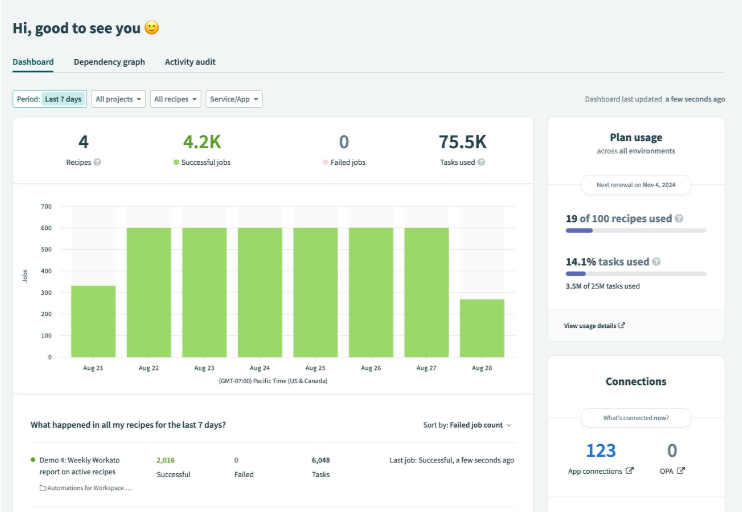
7. Workato – Best for Enterprise Application Integration
Workato is an enterprise-focused automation and integration platform designed to connect business applications, databases, and enterprise systems.
It is particularly useful for organizations operating with complex software environments.
Its automation workflows are known as recipes. These recipes allow businesses to define triggers, actions, conditions, and data transformations across connected applications.
For example, a company can synchronize employee information between its human resources platform, payroll software, identity management system, and internal communication tools.
Workato also supports more sophisticated integration requirements involving enterprise resource planning, customer relationship management, and other corporate applications.
Major features
- Enterprise application integration.
- Visual workflow automation.
- Prebuilt application connectors.
- API and data integration.
- Complex business process orchestration.
- Enterprise administration and governance.
- Automated data synchronization.
- AI-related automation capabilities.
Why businesses love Workato
Workato's biggest advantage is its ability to connect different business systems and coordinate processes across departments.
Organizations with multiple enterprise applications can use it to reduce manual data transfers and improve information consistency.
Its recipe-based approach also makes it possible to reuse automation logic across different business processes.
G2's 2026 iPaaS listings report a 4.7 out of 5 rating for Workato, reflecting strong user feedback in the integration-platform category. G2
Why businesses hate Workato
The biggest challenge is complexity.
Although its visual builder makes workflows easier to understand, advanced integrations can require considerable technical knowledge.
Implementation may also take time, particularly when businesses need to connect several enterprise applications and establish appropriate security controls.
Another disadvantage is pricing transparency. Workato generally requires businesses to request a quote, making it harder for smaller organizations to estimate costs before speaking with its sales team.
Who should use it?
Large corporations, multinational companies, financial institutions, enterprise IT departments, and businesses operating across several major software systems.
Verdict: Workato is a powerful enterprise automation platform, especially for organizations that need reliable connections between complex business applications. Its implementation requirements and custom pricing make it less attractive to smaller businesses.
Official website: Workato
8. Airtable – Best for Data-Driven Business Workflows
Airtable combines the familiarity of spreadsheets with the capabilities of a relational database and workflow management platform.
It allows businesses to organize information, build custom applications, manage projects, and automate processes.
Its flexibility makes it useful for companies that want to create internal systems without developing everything from scratch.
A marketing agency, for example, can use Airtable to maintain a content calendar, track campaign progress, assign tasks, and automatically notify team members when deadlines approach.
An e-commerce business can use it to organize product information, supplier details, and operational tasks.
Major features
- Spreadsheet-style database management.
- Workflow automation.
- Custom interfaces and dashboards.
- Project and task management.
- Application integrations.
- Data organization and reporting.
- AI-powered capabilities.
- Team collaboration.
Why businesses love Airtable
Airtable's biggest attraction is flexibility.
Businesses can build databases and operational systems that match their particular requirements rather than adjusting every process to fit a rigid software structure.
Its spreadsheet-style interface also makes it relatively approachable for employees who already understand tools such as Microsoft Excel and Google Sheets.
Another advantage is its ability to combine information management with automation. This makes it useful for managing projects, content production, customer records, and internal operations.
Why businesses hate Airtable
The platform can become expensive as the number of users and advanced requirements increases.
Another challenge is that Airtable is not a complete replacement for every database or enterprise resource planning system.
Businesses with complicated data relationships or high-volume transactional requirements may eventually need more specialized infrastructure.
There can also be a learning curve when building sophisticated interfaces, relational databases, and multi-step automation.
Who should use it?
Creative agencies, project management teams, media organizations, startups, marketing departments, and businesses that need flexible internal databases.
Verdict: Airtable is a strong choice for businesses that want to combine data management, collaboration, and automation. Its greatest advantage is flexibility, although companies with advanced database requirements should evaluate its limitations carefully.
Official website: Airtable
9. Automation Anywhere – Best for AI-Driven Enterprise Automation
Automation Anywhere is an enterprise automation platform that combines robotic process automation, artificial intelligence, document processing, and workflow orchestration.
Its primary objective is to help organizations automate business activities that involve several applications, documents, and decision-making stages.
For example, a financial institution can use automation to process incoming documents, extract relevant information, validate records, and send exceptions to employees for review.
The platform is also developing more advanced agentic automation capabilities, which allow AI-powered systems to participate in business workflows rather than simply execute fixed instructions.
Major features
- Robotic process automation.
- AI-powered process automation.
- Intelligent document processing.
- Workflow orchestration.
- Business process discovery.
- Automated data extraction.
- Enterprise governance.
- Human oversight and intervention.
Why businesses love Automation Anywhere
The platform is attractive to organizations that need to automate large volumes of repetitive work.
Its ability to combine bots, document processing, and AI-powered workflows makes it useful for departments handling substantial amounts of administrative information.
Businesses can use it to reduce manual data entry, improve processing speed, and standardize repetitive procedures.
It also offers a more comprehensive approach to automation than basic application-connection tools.
G2's 2026 listings report a 4.5 out of 5 rating for Automation Anywhere in the business automation platform category.
Why businesses hate Automation Anywhere
Its enterprise orientation can make implementation difficult for smaller companies.
Organizations may need specialized technical employees to design, deploy, monitor, and maintain automation projects.
The cost of deployment, training, and ongoing administration can also become significant.
Another concern is that AI-driven automation requires proper supervision. Businesses should not assume that an automated system can independently make every decision correctly, particularly when financial, legal, or customer-sensitive information is involved.
Who should use it?
Large corporations, banks, insurance companies, government agencies, and businesses with high-volume document-processing and administrative requirements.
Verdict: Automation Anywhere is a serious contender for enterprise automation. It is particularly attractive to organizations that want to combine traditional software robots with newer AI-driven business processes.
Official website: Automation Anywhere
10. monday.com – Best for Project and Team Management Automation
monday.com is a work management platform that helps businesses organize projects, coordinate employees, track progress, and automate repetitive team activities.
Its automation capabilities allow companies to create rules that trigger actions when particular conditions are met.
For example, when an employee completes a task, monday.com can automatically update the project status, notify the project manager, and assign the next activity to another team member.
This makes it particularly useful for businesses that manage several projects simultaneously.
Major features
- Project and task management.
- Automated task assignments.
- Workflow notifications.
- Custom dashboards.
- Project progress tracking.
- Team collaboration.
- Application integrations.
- AI-powered work management capabilities.
Why businesses love monday.com
Its user-friendly interface is one of its strongest advantages.
Employees can quickly understand project boards, deadlines, responsibilities, and workflow statuses.
The automation features also help reduce the amount of manual coordination required between team members.
Managers can create rules that automatically assign tasks, update statuses, and send reminders.
Another advantage is its flexibility. Businesses can adapt the platform to different departments, including marketing, operations, human resources, and project management.
Why businesses hate monday.com
The platform may not be powerful enough for organizations seeking advanced enterprise integration or complicated back-end automation.
Some businesses may also find its pricing structure difficult to manage as teams grow, particularly when they need additional users and premium features.
Another potential problem is that poorly organized boards can become cluttered. Companies need to establish clear project structures and workflow rules to get the most from the platform.
Who should use it?
Marketing agencies, creative teams, project managers, startups, remote businesses, and organizations that need better coordination between employees.
Verdict: monday.com is a practical choice for businesses that want to automate project management and team collaboration. It is not a substitute for every enterprise automation platform, but it can significantly reduce administrative work associated with managing projects.
Official website: monday.com
Business Automation Tools Compared: Which One Should You Choose?
The following table summarizes the strengths and limitations of the 10 platforms reviewed.
| Automation tool | Best use | Main advantage | Main drawback |
|---|---|---|---|
| Zapier | General business automation | Extensive integrations | Usage costs |
| Microsoft Power Automate | Microsoft businesses | Microsoft ecosystem integration | Licensing complexity |
| n8n | Technical automation | Customization and self-hosting | Requires technical knowledge |
| Make | Complex workflows | Visual workflow builder | Credit consumption |
| UiPath | Enterprise RPA | Automating legacy applications | Implementation complexity |
| HubSpot | Sales and marketing | CRM and automation together | Expensive advanced plans |
| Workato | Enterprise integration | Complex system connectivity | Custom pricing |
| Airtable | Data and workflow management | Flexible databases | Scaling costs |
| Automation Anywhere | AI and robotic automation | Enterprise process automation | Deployment complexity |
| monday.com | Project management | Team coordination | Limited advanced integration capabilities |
What Should Businesses Consider Before Buying Automation Software?
Selecting the right automation software requires more than comparing features. Businesses should consider their existing operations, available technical resources, expected growth, and the financial implications of introducing another subscription.
Here are five important considerations.
1. Identify the Tasks You Want to Automate
Businesses should first identify repetitive activities that consume employees' time.
Examples include:
- Sending customer follow-up emails.
- Processing invoices.
- Updating spreadsheets.
- Assigning tasks to employees.
- Collecting customer information.
- Generating performance reports.
- Managing appointment reminders.
- Updating inventory records.
Automating the right activities can deliver more value than purchasing an expensive platform with features the business rarely uses.
2. Examine Integration Compatibility
A good automation platform should work with the applications a business already uses.
For example, a company that depends heavily on Microsoft 365 may benefit more from Power Automate than from introducing an entirely separate automation environment.
Similarly, businesses that use several cloud applications may prefer Zapier or Make.
3. Understand the Actual Cost
Automation software can reduce operating expenses, but subscription fees, usage limits, implementation costs, and employee training must be considered.
A platform with a low entry price may become expensive when the business increases its automation activities.
Businesses should estimate their expected monthly usage before committing to a subscription.
4. Consider Security and Data Privacy
Automation systems may process customer information, employee records, financial documents, and other confidential business data.
Companies should examine access permissions, encryption, data retention, compliance requirements, and available administrative controls.
They should also avoid allowing AI-powered automation to make sensitive decisions without appropriate human supervision.
5. Consider Future Business Growth
The ideal platform should support the company's expected growth.
A tool that works perfectly for a five-person startup may not be suitable for an organization with hundreds of employees and complicated internal processes.
Businesses should consider scalability, workflow management, reporting, integration capabilities, and administrative controls before making a long-term decision.
Final Brief Review: Which Business Automation Tool Is Worth Using in 2026/27?
The 10 business automation tools reviewed in this article offer different advantages, and the best choice depends on what an organization wants to accomplish.
Zapier is our overall recommendation for businesses seeking straightforward automation without complicated technical requirements. Its extensive integration library makes it particularly attractive to startups, small businesses, and digital agencies.
Microsoft Power Automate is a strong alternative for companies already operating within the Microsoft ecosystem. It provides useful cloud and desktop automation capabilities.
n8n stands out for technical entrepreneurs and developers who want greater customization and control over their automation infrastructure.
Make deserves attention from businesses that need sophisticated visual workflows, while UiPath and Automation Anywhere are better suited to large organizations with extensive robotic automation requirements.
For customer-focused businesses, HubSpot offers an attractive combination of CRM, sales, and marketing automation. Meanwhile, Workato is particularly valuable for enterprise integration, Airtable for flexible data management, and monday.com for project and team coordination.
Ultimately, businesses should not purchase automation software simply because artificial intelligence and automation are popular in 2026. They should invest in platforms that solve genuine operational problems, reduce unnecessary expenses, improve productivity, and deliver measurable results.
The smartest approach is to begin with one or two repetitive processes, measure the improvements, and gradually introduce more automation as the business grows.
Leave a Comment
You must be logged in to post a comment.
November 5, 2026

Success in business and career development rarely happens overnight. It requires determination, discipline, patience, creativity, and the willingness to keep moving forward even when circumstances become challenging.
Whether you are an entrepreneur building a new business, a professional pursuing career advancement, or someone preparing to enter the world of work, the right words of encouragement can help you maintain a positive mindset.
Throughout history, successful entrepreneurs, business leaders, authors, and influential personalities have shared valuable lessons about achieving goals, overcoming obstacles, and making the most of available opportunities.
Their words continue to inspire people who want to build meaningful careers and successful businesses.
Sometimes, a simple quote can provide the motivation needed to take the first step, make a difficult decision, or keep working toward a long-term ambition.
Here are 10 of the best career and business quotes to inspire you, strengthen your determination, and encourage you to pursue professional and entrepreneurial success.
1. "Success is not final, failure is not fatal: It is the courage to continue that counts." – Winston Churchill
Success should never be viewed as the end of the journey, just as failure should not be considered the end of an opportunity. In business and career development, circumstances can change quickly. A successful business can experience difficult periods, while a struggling entrepreneur can eventually build a profitable company.
The important lesson is to remain determined regardless of the situation. People who achieve lasting success understand that setbacks are part of the process. Instead of allowing disappointment to stop their progress, they learn from their experiences and find better ways to move forward.
2. "Don't watch the clock; do what it does. Keep going." – Sam Levenson
Time management and consistency are essential qualities for anyone who wants to achieve professional success. Watching the clock without making meaningful progress will not bring you closer to your goals.
This quote encourages people to concentrate on their responsibilities and remain committed to their work. Whether you are managing a business, learning a new skill, or pursuing a demanding career, consistent effort can produce meaningful results over time.
Rather than becoming discouraged by how long success takes, focus on making progress every day.
3. "The only place where success comes before work is in the dictionary." – Vidal Sassoon
Every meaningful achievement requires effort. Although people often admire successful entrepreneurs and professionals, they may overlook the years of dedication, preparation, and hard work that helped them reach their positions.
Building a successful business involves planning, managing resources, understanding customers, and making difficult decisions. Similarly, career advancement requires continuous learning, experience, and professional development.
The message is straightforward: if you want to achieve something worthwhile, you must be prepared to put in the necessary work.
4. "Don't be afraid to give up the good to go for the great." – John D. Rockefeller
Sometimes, achieving greater success requires stepping outside your comfort zone. A career or business opportunity that appears satisfactory today may not provide the growth you desire in the future.
This does not mean abandoning every stable opportunity in pursuit of something uncertain. Instead, it encourages you to recognize when you have outgrown your current circumstances and when a carefully considered change could improve your future.
Successful professionals and entrepreneurs are often willing to explore new opportunities, develop better strategies, and challenge themselves to achieve more.
5. "You don't have to be great to start, but you have to start to be great." – Zig Ziglar
One of the biggest obstacles to achieving career and business success is waiting for the perfect moment. Many people have excellent business ideas or professional ambitions but never take action because they believe they lack enough experience, money, knowledge, or confidence.
This quote reminds us that greatness develops through experience. You do not need to have everything figured out before beginning a new journey.
If you want to start a business, begin by understanding your market and developing a practical plan. If you want to advance your career, start by acquiring relevant skills and seeking opportunities to improve.
Every successful journey begins with an initial step.
6. "The way to get started is to quit talking and begin doing." – Walt Disney
Ideas are important, but they become valuable when they are transformed into action. Many people spend considerable time discussing their ambitions without taking the practical steps needed to achieve them.
In business, having a promising idea is only the beginning. Entrepreneurs must research their markets, identify potential customers, develop products or services, and establish strategies for reaching their target audience.
The same principle applies to professional development. Instead of simply talking about acquiring new qualifications or improving your skills, take action and begin working toward those objectives.
Progress comes from implementation, not intention alone.
7. "Success usually comes to those who are too busy to be looking for it." – Henry David Thoreau
Success is often the result of concentrating on meaningful activities rather than constantly worrying about recognition or immediate rewards.
Professionals who dedicate themselves to improving their performance are more likely to develop valuable experience and earn opportunities for advancement. Entrepreneurs who focus on providing excellent products and services can also build stronger relationships with customers.
This quote highlights the importance of commitment and purposeful work. Instead of becoming distracted by comparing your achievements with those of others, concentrate on developing your abilities and delivering quality results.
8. "Opportunities don't happen. You create them." – Chris Grosser
Waiting for opportunities can limit your professional and business potential. Sometimes, the best opportunities emerge when you take the initiative to identify problems and develop solutions.
For entrepreneurs, this could mean discovering an underserved market, introducing a useful product, or improving an existing service. For employees and job seekers, it could involve networking, learning in-demand skills, volunteering for challenging assignments, or presenting innovative ideas.
The business world rewards people who recognize possibilities and are prepared to act on them. Rather than waiting for someone to offer you an opportunity, consider what you can do to create one.
9. "It's not about ideas. It's about making ideas happen." – Scott Belsky
Creativity is an important part of entrepreneurship and career development, but ideas alone rarely produce meaningful results. Execution is what turns an idea into something practical and valuable.
An entrepreneur may have an excellent concept for a business, but without proper planning, financial management, marketing, and customer engagement, that idea may never become a successful enterprise.
Likewise, professionals who consistently turn their suggestions into useful solutions can distinguish themselves in the workplace.
This quote is a reminder that planning is important, but taking action and following through are equally essential.
10. "The journey of a thousand miles begins with a single step." – Lao Tzu
Big ambitions can sometimes feel overwhelming, particularly when the desired results appear far away. However, every major achievement begins with smaller actions.
Building a profitable business, developing a successful career, or becoming an expert in a particular field takes time. You may not see significant results immediately, but every useful decision and positive action can contribute to long-term progress.
Instead of becoming discouraged by the distance between your current position and your ultimate goal, concentrate on what you can accomplish today.
Small improvements, when maintained consistently, can eventually lead to remarkable achievements.
Conclusion
Career and business success require more than ambition. They demand patience, discipline, determination, continuous learning, and the willingness to take action even when the outcome is uncertain.
These 10 career and business quotes offer valuable reminders about the importance of hard work, consistency, courage, and turning ideas into reality. Whether you are starting your first business, searching for a better career opportunity, or working toward professional advancement, their lessons can help you maintain the right attitude.
Remember that success is not always about making the biggest move or achieving immediate results. Sometimes, it is about staying focused, learning from mistakes, recognizing opportunities, and making steady progress.
Choose your goals, develop a practical plan, and take that first step. Your future achievements may begin with the actions you take today.
Leave a Comment
You must be logged in to post a comment.
November 4, 2026
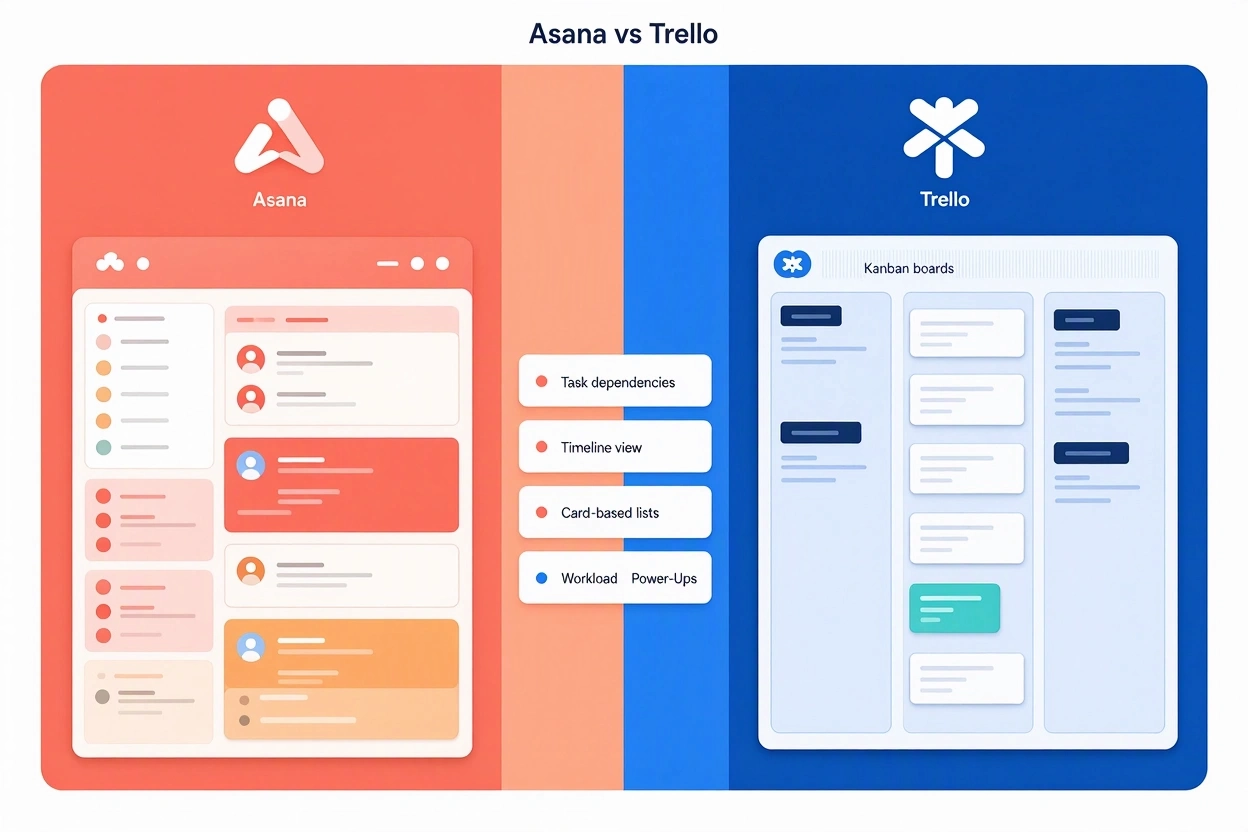
Asana and Trello are both collaborative work-management platforms, but they occupy different ends of the complexity spectrum. Trello is best for lightweight, visual task tracking, while Asana is better suited to structured, cross-functional project and portfolio management.
How Asana Works
Asana organizes work in a hierarchy: Goals → Portfolios → Projects → Tasks → Subtasks. A task is the basic unit of work and typically has an owner, due date, collaborators, description, attachments, comments, and custom fields.
Teams create a project for an initiative—such as a product launch, marketing campaign, or editorial calendar—then break it into sections, tasks, milestones, and dependencies. The same project can be viewed as a list, Kanban board, calendar, timeline, or Gantt chart without rebuilding the underlying data.
Asana’s automation feature, Rules, handles repetitive work such as assigning tasks, changing statuses, updating custom fields, and sending reminders. More advanced capabilities include portfolios for tracking related projects, workload views for capacity planning, forms for standardized work intake, and dashboards for reporting.
Its pricing begins with a free Personal plan for up to two users; Starter is $10.99 per user per month billed annually, and Advanced is $24.99 per user per month billed annually. Enterprise and Enterprise+ plans are custom-priced.
How Trello Works
Trello is built around a simple Kanban model: boards contain lists, and lists contain cards. A board represents a project, workflow, or shared workspace; a card represents a task, idea, request, or item moving through a process.
A card’s front shows quick details such as its title, labels, members, and due date, while its back can hold descriptions, checklists, attachments, comments, and activity history. Users move cards from one list to another—for example, from “To Do” to “In Progress” to “Done”—to show progress visually.
Trello’s automation tool, Butler, can automatically move cards, assign members, set due dates, archive items, and trigger actions based on board activity. It also offers Timeline, Table, Calendar, Dashboard, Map, and Workspace views, though some of these are limited to paid plans.
Trello’s free plan supports up to 10 collaborators per Workspace. Standard costs $5 per user per month billed annually, Premium is $10 per user per month billed annually, and Enterprise is $17.50 per user per month billed annually for organizations with 50 or more seats.
Similarities
| Area | Asana and Trello |
|---|---|
| Core purpose | Both help teams organize work, assign responsibility, set deadlines, and track completion. |
| Collaboration | Both support comments, mentions, attachments, due dates, assignees, and shared workspaces. |
| Kanban support | Both offer board views for visualizing work as it moves through stages. |
| Automation | Asana uses Rules; Trello uses Butler. Both reduce repetitive administrative work. |
| Integrations | Both connect with common business tools such as Slack, Google Drive, Gmail, Microsoft Teams, and calendar applications. |
| Flexible use cases | Both can be adapted for marketing, product work, IT requests, client projects, onboarding, and internal operations. |
| Freemium pricing | Both offer a free tier, with more advanced views, automation, reporting, and administration available in paid plans. |
The key distinction is that Trello treats the board as the primary organizing model, whereas Asana treats the task-and-project structure as primary and offers boards as one of several views.
How Businesses Use Them
Asana in organizations
Asana is commonly used where work spans multiple teams, dependencies matter, and leadership needs visibility. Marketing teams can plan campaigns on a timeline; product teams can manage roadmaps; operations teams can use forms and approvals; and executives can monitor portfolios and goals.
Its multi-homing feature allows one task to appear in multiple projects while remaining a single source of truth, which is useful for cross-departmental work. Portfolios then aggregate related projects, while dashboards and reports help managers identify overdue work, bottlenecks, and project health.
Asana is particularly valuable for organizations that need process discipline: task dependencies, Gantt-style planning, workload balancing, standardized intake forms, and company-wide reporting.
Trello in organizations
Trello is often used as a visual operating system for smaller teams or simpler workflows. Businesses use it for content pipelines, sales pipelines, client-service queues, IT request tracking, onboarding checklists, meeting agendas, and resource hubs.
For example, a sales team can create columns such as “New Lead,” “Contacted,” “Proposal Sent,” and “Closed,” with each prospect represented as a card. Labels can show priority, checklists can track next steps, and Butler can automatically assign follow-up tasks or move cards when a stage changes.
Trello Enterprise adds centralized administration, permissions, SAML SSO through Atlassian Guard, security controls, and support for larger organizations.
Positive Feedback
Trello
Users consistently praise Trello for being easy to learn, visual, and fast to adopt. G2 reviewers frequently highlight its intuitive drag-and-drop interface, clear task organization, flexibility, and strong collaboration features.
Capterra reviewers also emphasize its real-time collaboration, centralized communication, file sharing, checklists, labels, due dates, and Butler automation. Many say teams can become productive within minutes and without formal training.
Trello’s major strengths are:
- Very low onboarding effort and minimal training requirements.
- Clear visual progress tracking through boards, lists, and cards.
- Strong value for small and mid-sized teams.
- Flexible boards that can model many workflows, from content production to CRM and IT requests.
- Useful automation through Butler.
Asana
Asana receives strong feedback for its clean interface, task accountability, workflow capabilities, and project visibility. G2 users frequently praise its task management, collaboration, workflow features, and ability to keep work organized.
Users also value its multiple project views, integration with Google Calendar, deadline reminders, automations, and ability to connect everyday work to broader goals.
Asana’s major strengths are:
- Strong structure for complex, multi-team projects.
- Timeline, Gantt, dependencies, milestones, and workload planning.
- Portfolios and dashboards for management-level visibility.
- Rules that automate recurring workflow steps.
- Better fit than Trello for scaling cross-functional operations.
Negative Feedback
Trello
The most common criticism of Trello is that its simplicity becomes a limitation as projects grow. G2 users frequently mention limited features, weak native reporting, limited customization, and difficulty visualizing dependencies between tasks.
Capterra reviewers report that large boards can become cluttered, that reporting often requires third-party tools or paid Power-Ups, and that the platform is less suitable for complex projects requiring resource management or native Gantt charts.
Common Trello complaints include:
- Limited native reporting and analytics.
- Weak support for complex task dependencies.
- Boards can become messy as card volume increases.
- Advanced views and automation may require paid plans.
- Some users find notifications inconsistent or overwhelming.
Asana
Asana’s main criticism is that its depth can create a steeper learning curve. G2 reviewers commonly cite difficulty with rules, project organization, search, navigation, and setup for complex workspaces.
Users also report notification overload, especially when participating in multiple projects, and frustration that advanced reporting, automation, portfolios, and workload features are restricted to higher-priced tiers.
Common Asana complaints include:
- Steeper learning curve than Trello.
- Excessive notifications if settings are not customized.
- Important reporting and automation features locked behind premium plans.
- Can feel overwhelming in large or poorly structured projects.
- Some users find task and subtask movement less intuitive than expected.
Overall Review
| Criterion | Asana | Trello |
|---|---|---|
| Best for | Cross-functional teams, structured projects, portfolios, and process-driven work. | Small teams, simple workflows, visual task tracking, and quick adoption. |
| Ease of use | Good, but more setup and learning required. | Excellent; boards are intuitive and require little training. |
| Project planning | Strong: dependencies, timelines, Gantt charts, milestones, workload. | Basic to moderate: Timeline and Calendar exist, but depth is limited. |
| Reporting | Strong dashboards, portfolios, and project reporting. | Basic native reporting; advanced insight often needs paid views or integrations. |
| Automation | Rules for task assignment, status changes, reminders, and workflow handoffs. | Butler for card moves, assignments, due dates, and board maintenance. |
| Scalability | Better for larger organizations and complex programs. | Better for small teams; can become cluttered at scale. |
| Starting price | Free Personal plan; Starter at $10.99 per user/month annually. | Free for up to 10 collaborators; Standard at $5 per user/month annually. |
| Main drawback | Complexity, notifications, and premium-feature paywalls. | Limited depth for complex projects and reporting. |
Verdict
Choose Trello if your team wants a fast, inexpensive, visual tool for straightforward task management, content workflows, client pipelines, or lightweight project coordination. It is especially strong for teams that value simplicity and can keep boards well organized.
Choose Asana if your organization needs a more complete work-management system with dependencies, timelines, portfolios, workload planning, reporting, and cross-team coordination. It costs more and takes more effort to configure, but it is substantially better equipped for complex business operations.
In short: Trello wins on simplicity and adoption speed; Asana wins on structure, visibility, and scalability. For a small team managing uncomplicated work, Trello is usually the more practical choice. For a growing organization coordinating multiple departments and dependent workstreams, Asana is the stronger long-term platform.
Leave a Comment
You must be logged in to post a comment.
November 2, 2026
Digital Marketing Learning Roadmap: From Beginner to Expert

Digital marketing combines creativity, data, and technology to help brands reach and engage people online. This roadmap gives you a practical, step-by-step path: learn the fundamentals, practice through projects, specialize in a high-demand area, and build a portfolio that demonstrates measurable results. Digital marketing spans channels such as search engines, websites, social media, email, and online advertising.
How to Use This Roadmap
Treat this as a flexible guide rather than a rigid schedule. Start with the foundations, complete small projects as you learn, then choose a specialization that matches your interests and career goals. Revisit earlier sections as your skills develop, and use the portfolio guidance to turn practice work into evidence employers can evaluate.
Build the Foundations
Before running campaigns or using advanced tools, learn the vocabulary and logic behind digital marketing. Core concepts include the customer journey, content strategy, SEO, paid versus organic traffic, conversion, analytics, and key performance indicators (KPIs).
Focus on these fundamentals:
- Marketing channels: Search, social media, email, websites, display advertising, and mobile.
- Customer journey: How people discover a brand, evaluate options, and decide to buy or subscribe.
- Content strategy: Creating useful, relevant content that attracts and retains a defined audience.
- SEO: Improving the quality and quantity of organic search traffic to a website.
- Paid advertising: Buying visibility through channels such as search ads and social ads; pay-per-click (PPC) is a common model in which advertisers pay when someone clicks an ad.
- Conversion: Getting a visitor to complete a desired action, such as purchasing, signing up, or submitting a form.
- Analytics and KPIs: Measuring traffic, engagement, conversions, and campaign performance to guide decisions.
Learn Core Workflows
Digital marketing work follows repeatable processes. Practice each workflow early so you can connect strategy to execution.
| Workflow | What it involves | Practice activity |
|---|---|---|
| Campaign planning | Define goals, audience, channels, message, budget, and timeline | Write a one-page campaign brief for a product you like |
| Content creation | Develop copy, visuals, video, or email content | Draft a social post and a short blog introduction |
| SEO optimization | Research keywords and improve on-page content | Identify keywords for a blog topic and suggest page improvements |
| Performance tracking | Review metrics and identify trends | Examine a sample analytics dashboard and summarize two insights |
| Ad management | Set up, monitor, and optimize paid campaigns | Explore Google Ads or Meta Ads Manager and draft a sample campaign |
Practice With Tools
Hands-on practice matters more than passive reading. Use demo accounts, sandboxes, and free trials to explore platforms without risking real budgets.
Useful first tools include:
- Google Analytics: Track website traffic, user behavior, and campaign performance.
- Google Ads: Plan and measure paid search campaigns.
- Meta Ads Manager: Create and optimize campaigns for Facebook and Instagram.
- SEMrush or Ahrefs: Conduct keyword research, SEO audits, and competitor analysis.
- Mailchimp: Build, send, and analyze email campaigns.
- Canva: Create visuals for social posts, ads, and emails.
- Hootsuite or Buffer: Schedule and manage social media content.
- WordPress or Wix: Build landing pages and simple websites.
- Trello or Asana: Organize campaign tasks and collaborate with others.
First Practice Session
In your first 60–90 minutes, try to:
- Create a free account on a marketing simulator, email platform, or website builder.
- Explore the dashboard and locate the main reporting features.
- Draft a sample social post, email, or ad.
- Research keywords for a topic you enjoy.
- Review a sample analytics report.
- Identify two metrics that could indicate whether a campaign is working.
Build Skills Through Projects
Projects turn knowledge into experience. Start with small, well-defined assignments, then increase complexity as you become comfortable.
| Project | Skills practiced | Suggested time |
|---|---|---|
| Create a one-month social media calendar for a small business | Audience research, content planning, scheduling, brand voice | 2–3 hours |
| Draft a simple Google Ads campaign | Keyword research, ad copy, budgeting, performance tracking | 3–4 hours |
| Analyze one month of website traffic | Analytics setup, metric interpretation, reporting | 2–3 hours |
| Design an email campaign with segmentation and A/B testing | Email copy, segmentation, testing, campaign analysis | 3–5 hours |
| Improve a landing page for conversions | UX, copywriting, conversion tracking, testing | 4–6 hours |
For every project, document the challenge, your approach, the tools you used, the decisions you made, and the results or expected outcomes. Even simulated projects can demonstrate strategic thinking, technical ability, and familiarity with marketing workflows.
Choose a Specialization
After building broad foundations, develop deeper expertise in one or two areas. This makes your portfolio more focused and helps you target relevant roles.
SEO Strategy
SEO focuses on increasing organic visibility in search results through keyword research, content optimization, technical improvements, and link-building. Strong evidence of skill includes SEO audits, keyword maps, optimized pages, and before-and-after search performance data.
Social Media and Content Marketing
This specialization covers content planning, platform strategy, community engagement, and campaign execution. Build proof through social calendars, creative assets, engagement reports, and multi-platform campaign examples.
Paid Advertising and Performance Marketing
Performance marketers plan, launch, and optimize paid campaigns across search, social, and display channels. Learn to track cost-per-click, cost-per-acquisition, return on ad spend, and conversion performance.
Email Marketing and Automation
Email marketers build subscriber lists, segment audiences, write campaigns, and create automated customer journeys. Useful portfolio pieces include drip campaigns, segmentation strategies, A/B tests, and open and click-through rate reports.
Analytics and Conversion Optimization
This path emphasizes measuring performance, interpreting user behavior, and improving conversion rates. Practice funnel analysis, A/B testing, dashboard creation, and data-driven recommendations. Conversion rate optimization focuses on increasing the percentage of users who complete a desired action.
Learn Effectively
Consistent practice is more valuable than occasional long study sessions. Digital marketing also rewards curiosity, feedback, and familiarity with emerging tools.
- Spend 20–30 minutes daily reading reputable industry newsletters or blogs.
- Practice one tool feature or platform update each day.
- Create or publish sample content weekly.
- Review campaign metrics at least twice a week.
- Reflect weekly on what worked, what did not, and what you would change.
- Join professional communities on LinkedIn, Reddit, or local marketing groups.
- Volunteer to support a nonprofit, student organization, or small business.
- Use AI tools to brainstorm, draft, or analyze—but edit outputs carefully and verify insights before acting on them.
Build a Portfolio
Your portfolio should show how you think, not just what you can create. Organize it by skill area—such as SEO, paid media, social media, email, and analytics—and make it easy for a recruiter to navigate.
Include:
- Campaign summaries with goals, audience, strategy, and results.
- Screenshots or links to dashboards, ads, emails, landing pages, and social content.
- Before-and-after metrics where available.
- Short reflections on challenges, decisions, and lessons learned.
- Visual assets such as graphics, ad creative, or infographics.
- Clear dates and version history to show progression.
A personal website, LinkedIn profile, or well-organized shared folder can make your work accessible to employers and collaborators.
Prepare for the Job Market
Employers commonly look for practical tool experience, content creation ability, analytical thinking, and evidence that a candidate can improve campaign performance. Common roles include digital marketing specialist, social media coordinator, content marketer, email marketing associate, paid ads specialist, SEO assistant, and e-commerce associate.
Prepare for interviews by being able to explain:
- Why you chose a particular channel or audience.
- How you developed campaign messaging.
- Which metrics you tracked and why.
- What you would test or improve next.
- How you responded to feedback or underperforming results.
Resume Bullet Examples
- Developed and managed multi-platform campaigns using Google Ads and Meta Ads Manager, tracking engagement and conversion metrics.
- Created weekly Google Analytics reports to identify traffic trends and recommend strategy adjustments.
- Designed social media and email content aligned with brand voice and audience needs.
- Conducted keyword research and on-page SEO improvements using SEMrush.
- Planned content campaigns using the AIDA framework: Attention, Interest, Desire, and Action.
Frequently Asked Questions
Do I need a degree to start?
No. A degree can help, but many entry-level digital marketing roles prioritize demonstrated skills, tool familiarity, and a portfolio of practical work.
How long does it take to learn digital marketing?
You can learn the fundamentals in a few weeks, but becoming job-ready usually takes several months of consistent study, practice projects, and portfolio development.
Which specialization should I choose first?
Choose based on your strengths: SEO and analytics suit detail-oriented learners; social media and content suit creative communicators; paid advertising suits people who enjoy testing, budgets, and performance data.
Can AI replace digital marketers?
AI can accelerate research, drafting, design, and analysis, but marketers still need strategic judgment, audience understanding, brand consistency, ethical oversight, and the ability to interpret results.
Digital marketing rewards learners who combine creativity with measurement. Build your foundation, practice publicly, specialize deliberately, and keep a portfolio that shows both your process and your impact.
Leave a Comment
You must be logged in to post a comment.

Semrush has grown far beyond a basic keyword checker into an all-in-one digital marketing hub. If you are looking to maximize its ROI for a brand or client, here are five actionable campaign and strategy ideas built around its advanced toolkit.
1. Reverse-Engineer a Competitor's Paid Ad Strategy
Instead of guessing what ad copy or keywords will convert, use Semrush to see exactly what your successful competitors are paying for.
- The Workflow: Plug a top competitor's domain into the Advertising Toolkit, utilizing Advertising Research and AdClarity.
- The Play: Filter their history to find ads that have been running for 3+ months. If they’ve been spending budget on the exact same ad copy for a quarter or longer, it is almost certainly driving a positive ROI. Break down their headlines, analyze their landing page design, and identify the exact keywords triggering those ads. By pinpointing the specific offer—whether it’s a free trial, a discount, or a whitepaper—you can model your own PPC campaign after their proven success, eliminating the "testing phase" waste.
2. Hijack "Low-Difficulty" Content Gaps
Writing high-volume content is useless if you can't rank for it. This play focuses entirely on finding low-hanging fruit your competitors missed.
- The Workflow: Run a Keyword Gap analysis between your site and 3–4 direct competitors. Filter the results by "Missing" or "Weak" keywords (terms they rank for, but you don't).
- The Play: Apply a strict advanced filter: set the Keyword Difficulty (KD) to "Easy" (below 30%) and filter for "Informational Intent." This spits out a precise hit-list of specific questions your audience is asking that require very little domain authority to rank on page one. Export these to the SEO Content Template, which provides automated suggestions on subheadings and semantically related keywords, allowing you to build a content cluster that dominates a niche in weeks rather than months.
3. Track and Dominate "AI Visibility" (GEO)
Generative Engine Optimization (GEO) is just as critical as traditional SEO. You need to know if LLMs (like Google's AI Overviews, Perplexity, or ChatGPT) are citing your brand when users ask questions.
- The Workflow: Use Semrush's AI Visibility tracking features within the Position Tracking tool. Input your brand name alongside your top competitors to monitor how often you appear in AI-generated responses.
- The Play: Analyze the queries where your competitors are being cited but you are left out. Look at the structure of their winning content; frequently, AI engines prioritize "concise, bulleted answers" with clear schema markup. Restructure your own content to mirror this format, explicitly defining terms in the first 100 words and using FAQ-style schema. By becoming the "source of truth" for AI models, you capture traffic before the user even clicks a traditional search result.
4. Build a High-Authority PR Outreach Machine
Backlinks remain a primary ranking factor, but spamming site owners is a losing strategy. Use Semrush to land genuine digital PR features and high-quality links through data storytelling.
- The Workflow: Use the Topic Research tool combined with Exploding Topics to identify fast-rising trends in your industry before they hit the mainstream media.
- The Play: When you spot an emerging trend, conduct proprietary research or aggregate unique data points on your site. Use the Link Building Tool to identify journalists who cover that specific beat. Instead of a generic pitch, send them your data-backed mini-report as a resource for their upcoming stories. Journalists are constantly under pressure to provide "new" angles; providing them with pre-processed data and charts makes you a valuable partner rather than a nuisance, earning you high-DR backlinks from reputable news outlets.
5. Automated "Quick-Win" Technical Audits for Lead Gen
If you are operating as an agency or freelancer, you can use Semrush’s data as a highly effective, low-friction client-acquisition hook.
- The Workflow: Set up a project in the Site Audit tool for a high-value prospect's website. Configure the report to focus exclusively on "Critical Issues" like broken internal links (404 errors) or slow Core Web Vitals.
- The Play: Avoid sending an overwhelming, 50-page technical PDF. Instead, craft a "10-minute audit" email. Attach a screenshot of their lowest technical score—for example, a "Page Load Time" metric that is clearly costing them conversion—and explain in plain English how this specific error is driving customers to their competitors. Frame the fix not as a "technical service," but as "lost revenue recovery." Offering to walk them through a 15-minute screen-share on how to resolve these quick wins makes it nearly impossible for a prospect to ignore your reach-out.
Proper SEO keywords serve as the foundational bridge between what potential customers are searching for and the content digital marketers create. Without targeted keyword research, digital marketing strategies risk driving irrelevant traffic or missing high-intent audiences entirely.
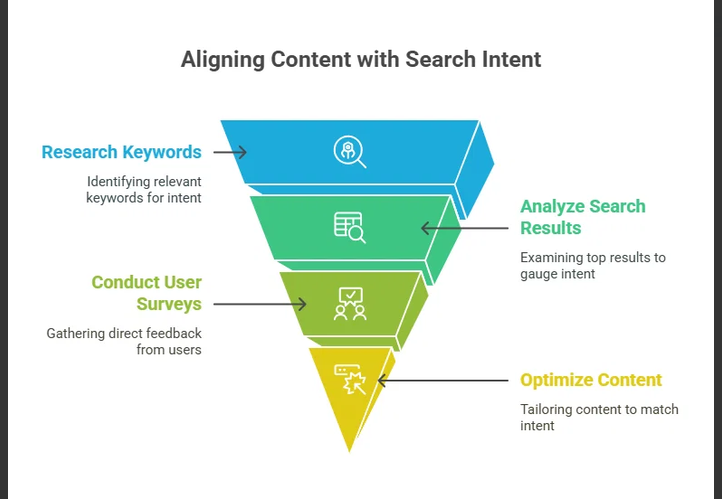
Strategic Value of Proper Keyword Research
- Connecting with High-Intent Audiences: Proper keywords allow marketers to target specific search intent—distinguishing between users looking for information ("how to style a WordPress theme") versus users ready to make a purchase ("best agency WordPress theme").
- Maximizing ROI on Content Creation: Ranking high on search engines requires dedicated time and resources. Keyword targeting ensures that content production efforts focus on topics with verified search volume rather than low-value topics.
- Informing Site Architecture & Navigation: Keyword clusters guide how pages, categories, and internal links should be structured. A well-organized site structure improves user navigation and helps search engine crawlers understand topical authority.
- Optimizing Paid Ads (PPC): In pay-per-click campaigns, choosing exact match and long-tail negative keywords directly prevents wasted ad spend on irrelevant clicks, significantly lowering cost per acquisition (CPA).
- Competitive Advantage: Analyzing competitor keyword gaps reveals underserved niches and long-tail opportunities that larger competitors may have overlooked.
Keyword Intent Breakdown
| Intent Category | Search Goal | Example Query | Primary Strategy |
| Informational | Learn a concept or fix an issue | How to fix CSS layout bugs | In-depth blog posts, tutorials, guides |
| Navigational | Reach a specific site/brand | Elementor login | Clean landing pages, branded SEO |
| Commercial | Research before buying | Frost vs Astra WordPress theme | Comparison tables, reviews, feature lists |
| Transactional | Complete a purchase or sign up | Buy domain name fast | Conversion-focused landing pages, clear CTAs |
FAQ
How do I perform a keyword gap analysis against competitors?
A keyword gap analysis identifies search terms that your direct competitors rank for, but your website either misses entirely or ranks poorly for.
1.Identify 3–5 Core Competitors:Prerequisite for accurate comparison data.
Select competitors into two distinct buckets:
- Direct Business Competitors: Brands offering identical products or services.
- Organic Search Competitors: Sites ranking at the top of Google for your target topics (even if they don't sell competing products, like industry blogs or news outlets).
2.Run a Gap Comparison Tool:Requires Semrush, Ahrefs, Moz, or Google Keyword Planner.
Enter your primary domain alongside 2–4 competitor domains into a dedicated Keyword Gap / Content Gap tool.
Set the location filter to match your primary target region (e.g., United States or United Kingdom).
3.Filter Results into Gap Categories:Focus on high-opportunity keyword sets.
Segment your raw comparison report into three primary views:
- Missing: Keywords where competitors rank in top 50, but your site does not rank at all.
- Weak: Keywords where both you and competitors rank, but competitors outrank you by 10+ positions.
- Shared (Top Positions): Keywords where you already outrank them (protect these rankings).
4.Apply Volume & Intent Benchmarks:Filter out irrelevant or unachievable terms.
Narrow down the "Missing" list by applying strict parameters:
- Search Volume: Filter for terms with meaningful search volume suitable for your niche (e.g., $>100$ monthly searches).
- Keyword Difficulty (KD): Focus on keywords where competitor Domain Ratings are comparable to yours.
- Intent Match: Group terms by commercial, transactional, or informational intent.
5.Map Gaps to Actionable Content Tasks:Execution phase.
Assign each target keyword group to an action item:
- Create New Pages: For "Missing" keywords requiring entirely new landing pages or blog posts.
- Update & Expand Existing Pages: For "Weak" keywords where adding new sections or updating metadata on current pages can reclaim rankings.
Key Metrics to Evaluate Opportunity
| Metric | What to Look For | Actionable Takeaway |
| Search Volume | High to moderate monthly query count | Indicates traffic potential |
| Keyword Difficulty (KD) | Equal to or lower than your domain strength | Indicates realistic chance to rank |
| Competitor URL Type | Product page vs. blog post | Dictates what page format you must build |
| Search Intent | Informational, commercial, transactional | Determines call-to-action and layout |
FAQ
How do I explain the trade-offs between long-tail and short-tail keywords in digital marketing?
The central trade-off in keyword selection balances reach versus relevance: short-tail keywords deliver high traffic volumes but lower conversion efficiency, while long-tail keywords deliver lower search volume with significantly higher user intent and conversion rates.
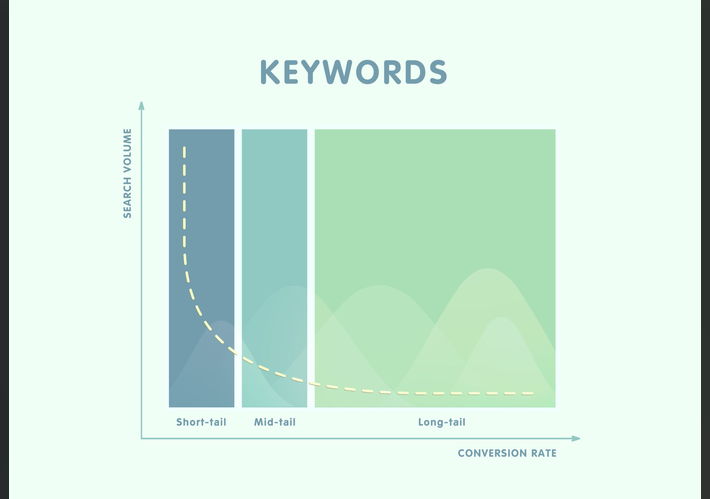
Direct Comparison
| Feature | Short-Tail Keywords | Long-Tail Keywords |
| Word Count | 1 to 2 words | 3+ words (often phrases or questions) |
| Example Query | WordPress themes | best lightweight block theme for blog performance |
| Search Volume | Very high (tens of thousands per month) | Low to moderate (tens to hundreds per month) |
| Search Intent | Broad / Ambiguous | Specific / Actionable |
| Competition | Extremely high (dominated by established domains) | Low to moderate |
| Conversion Rate | Low (typically 1%–2%) | High (often 5%–10%+) |
| PPC Cost-Per-Click (CPC) | Expensive due to high bidding competition | Lower cost per click |
| Time to Rank (SEO) | Months to years | Days to weeks |
Detailed Trade-Off Analysis
Short-Tail Keywords ("Head Terms")
- Pros:
- Brand Visibility & Awareness: Ranking for head terms establishes authority and puts your brand in front of thousands of top-of-funnel users.
- Broader Audience Capture: Drives massive raw site traffic, which can be useful for ad-monetized publishing sites or building retargeting lists.
- Cons:
- Vague Search Intent: A user searching for "shoes" could want history, manufacturing info, trends, or direct purchasing—making content targeting difficult.
- Resource Intensive: Requires significant domain authority, extensive backlink profiles, and high ad budgets to compete effectively.
Long-Tail Keywords
- Pros:
- High Conversion Rates: Users using specific queries know what they want and are further down the buying funnel.
- Faster SEO Gains: Lower keyword difficulty allows newer or smaller sites to rank quickly on page 1 of search results.
- Easier Content Alignment: Highly specific questions translate directly into targeted blog posts, FAQs, and product landing pages.
- Cons:
- Low Individual Volume: Single terms yield fewer total visitors, requiring a portfolio of dozens or hundreds of long-tail pages to aggregate major site traffic.
- Scalability Effort: Producing tailored content for multiple niche queries demands ongoing editorial planning and production effort.
Recommended Strategy: The "Hub and Spoke" Model
Instead of choosing one over the other, effective digital marketing strategies combine both using topical clusters:
- Pillar/Hub Pages: Target broad short-tail keywords on comprehensive overview pages (e.g., "Web Design Guide").
- Cluster/Spoke Content: Target long-tail keywords on specific articles or product pages (e.g., "How to customize navigation menus in WordPress block themes").
- Internal Links: Pass link equity from long-tail spoke pages back to the main short-tail pillar page to build overall topical authority.
FAQ
How do I design a topic cluster and pillar page model for my website?
Designing a topic cluster model requires organizing a broad overarching subject into a central "Pillar Page" supported by a network of specific "Cluster Content" pages, all connected through deliberate internal linking.
1.Select a Core Pillar Topic:Choose a high-level subject broad enough for 5–10 subtopics.
Identify a broad, short-tail head term relevant to your core business or service (e.g., WordPress Site Performance or Email Marketing).
- Ensure the term has high search volume.
- Confirm the topic can be naturally broken down into sub-components.
2.Conduct Cluster Keyword Research:Find specific questions, long-tail terms, and niche angles.
Brainstorm and research 5 to 10 subtopics targeting specific long-tail keywords associated with the main pillar.
- Use tools like AnswerThePublic, Semrush, or Google "People Also Ask."
- Focus on informational or transactional queries (e.g., How to optimize image sizes for web, Best caching plugins for WordPress).
3.Draft Content for Pillar and Clusters:Broad overview vs. deep-dive specifics.
Write and structure the content with distinct scopes:
- Pillar Page: Serves as an ultimate guide (typically 2,000–4,000+ words). It introduces every subtopic at a high level without going too deep into technical implementation.
- Cluster Pages: Deep-dive posts (1,000–2,000 words) that cover a single subtopic thoroughly with actionable, step-by-step detail.
4.Implement Internal Linking Architecture:The critical SEO connection that establishes topical authority.
Establish deliberate two-way contextual hyperlinks:
- Pillar to Cluster: Every subtopic section on the pillar page must link out to its corresponding cluster page using descriptive anchor text.
- Cluster to Pillar: Every cluster page must include a contextual link back to the main pillar page early in the body text.
- Cluster to Cluster: Interlink relevant cluster pages where naturally helpful for user navigation.
Example Topic Cluster Architecture
| Element | Component Role | Example URL & Target Keyword | Content Depth |
| Core Pillar | Central Hub Guide | /wordpress-performance-guide/(WordPress Site Performance) | High-level summary of speed factors, hosting, caching, and image optimization. |
| Cluster 1 | Subtopic Deep Dive | /how-to-optimize-images-wordpress/(optimize images wordpress) | Complete tutorial on WebP formats, compression plugins, and lazy loading. |
| Cluster 2 | Subtopic Deep Dive | /best-wordpress-caching-plugins/(best caching plugins wordpress) | Product comparisons, benchmarks, and configuration setups for top caching tools. |
| Cluster 3 | Subtopic Deep Dive | /reduce-unused-css-javascript/(reduce unused CSS wordpress) | Technical walkthrough on asset cleanups, code minification, and critical CSS rendering. |
Leave a Comment
You must be logged in to post a comment.
How to Succeed with Digital Marketing & Automation in The World Wide Web

Let’s be honest for a second: the World Wide Web is exhausted.
Every time you open a browser tab, you are immediately bombarded by cookies to accept, newsletters to join, pop-ups offering 10% off, and re-targeting ads tracking you from that one pair of boots you looked at three weeks ago. We’ve built a digital ecosystem that feels less like an information highway and more like a high-pressure timeshare presentation.
As someone who spends a lot of time analyzing how brands talk to humans online, I’ve been thinking deeply about where we are with digital marketing and automation. We are living through a massive paradigm shift. The old playbook is broken, the tools are getting scarily smart, and the line between "efficient marketing" and "spammy white noise" has never been thinner.
Here is my take on where the web is heading, what’s actually working, and why the future of marketing might require us to use a lot more machine intelligence—but a whole lot more human soul.
The Automation Trap: When Scale Kills Connection
Automation was supposed to be our savior. The promise was beautiful: automate the tedious tasks so you can focus on high-level strategy.
Instead, we used it to build a fire-hose of mediocrity.
Because it’s now incredibly easy to automate a 12-part email sequence, generate 50 generic blog posts via AI in an afternoon, or program a chatbot to say "Hi there! How can I help you today? 👋", everyone did exactly that. The web became flooded with content that has no point of view, sent by brands that feel entirely faceless.
The Reality Check: When you automate a bad process, you don't make it better; you just scale the annoyance.
When a brand automates its social media responses to the point where a frustrated customer gets a cheery, robotic reply, that isn’t efficiency—it’s a liability. True automation shouldn't feel mechanical to the end-user. It should act like an invisible concierge, quietly clearing the friction out of the way before the customer even realizes it’s there.

Smart Automation: Flipping the Script
Look, I’m not a luddite. I love data, and I love smart engineering. Automation is brilliant when it is used for contextual relevance rather than sheer volume.
The best digital marketing happening right now uses automation to respect a user’s time, not steal it. Here is what smart automation looks like in practice:
Behavioral Triggers Over Calendars: Instead of blasting a newsletter every Tuesday at 9:00 AM just because it’s Tuesday, smart systems wait until a user demonstrates explicit intent—like revisiting a specific pricing page three times—and then delivers a highly tailored, hyper-specific resource.
Predictive Customer Service: Using machine learning to anticipate when a client might need a refill, a check-in, or a technical upgrade, and triggering a personalized outreach before they have to ask.
Data Aggregation, Not Content Creation: Using automation to handle the heavy lifting of tracking metrics, segmenting audiences, and cleaning lists, which frees up human brainpower to write copy that actually makes people feel something.
The Premium on Raw Human Authenticity
Here is the silver lining in all of this: because the web is drowning in automated, synthesized noise, unfiltered human authenticity has become a premium commodity.
People can smell an AI-generated LinkedIn thought-piece from a mile away. They know when a brand's "apology" was run through a corporate PR filter. In a landscape of perfectly polished, automated corporate speak, the raw, vulnerable, and slightly messy human voice wins every single time.
The most successful digital marketing strategies today don't look like marketing at all. They look like:
A founder filming a quick, unedited video on their phone explaining a product flaw and how they're fixing it.
An email newsletter written in the first person that reads like it’s coming from an eccentric, brilliant friend rather than a marketing department.
Communities (like Discord channels or specialized subreddits) where real conversations happen without a salesperson lurking in the shadows.
Where We Go From Here
The World Wide Web is entering a mature phase. The novelty of being reached anywhere, at any time, has completely worn off for consumers. Privacy regulations are tightening, tracking cookies are crumbling, and users are actively retreating into private digital spaces to escape the noise.
If you want your digital marketing to survive the next decade, the goal cannot be to see how much of your relationship with the customer you can outsource to a machine.
The goal should be to use automation to handle the data, the tracking, and the operational logistics, so that when your brand finally speaks to a human being, it sounds exactly like one.
Let's build a web that's a little less automated for the sake of metrics, and a lot more intentional for the sake of people.
Who's Digital Marketing and Automation For?
The digital landscape has shifted from manual outreach to intelligent, system-driven engagement. While the tools of modern growth—search engine optimization, targeted advertising, email sequences, and customer relationship management (CRM) workflows—are widely accessible, a fundamental question remains: who is digital marketing and automation actually for?
The short answer is that it is for any entity looking to scale communication without multiplying manual effort. However, its specific value varies depending on the structure and goals of the user.
- Solopreneurs, Creators, and Micro-Businesses
For single-operator businesses, time is the scarcest asset. Solopreneurs—ranging from niche content creators and consultants to freelance service providers—wear every operational hat simultaneously.
Digital automation acts as a virtual workforce for these individuals. Instead of manually responding to every lead or sending individual follow-up emails, automated systems handle:
Lead Capture & Nurturing: Delivering lead magnets and triggering targeted email onboarding series automatically.
Content Distribution: Scheduling cross-platform social media posts and newsletters.
Client Onboarding: Automating appointment bookings, intake forms, and payment collection.
For this group, automation is not just about efficiency; it is about survival and preventing burnout while maintaining a professional presence.
- Small to Mid-Sized Businesses (SMBs)
Small and growing companies often face a distinct challenge: competing against enterprise budgets with limited internal bandwidth. Digital marketing levels the playing field by allowing SMBs to target precise local or global audiences, while automation ensures high operational efficiency.
For SMBs, these technologies streamline:
Customer Relationship Management: Tracking prospect interactions and scoring leads so sales reps focus only on high-intent prospects.
Customer Retention: Triggering re-engagement campaigns, birthday offers, and automated review requests post-purchase.
Ad Campaign Optimization: Using algorithmic bidding to maximize return on ad spend (ROAS) across search and social channels.
Automation bridges the gap between a small team's capacity and an enterprise-level customer experience.
- E-Commerce and Digital Retailers
Online stores operate continuously, receiving traffic and orders at all hours. Manual customer tracking is impossible at scale.
E-commerce brands rely heavily on behavioral automation to convert passive visitors into repeat buyers through:
Cart Abandonment Recovery: Sending timely, personalized email or SMS reminders to users who leave items behind.
Post-Purchase Sequences: Delivering order updates, usage guides, and tailored cross-sell recommendations.
Dynamic Segmentation: Categorizing shoppers based on browse history, lifetime value, and purchase frequency.
- Marketing Agencies and Growth Teams
For agencies managing multiple client portfolios, digital automation is the core engine of scalable operations. It enables growth teams to monitor multi-channel campaigns, pull cross-platform analytics into unified dashboards, and deliver consistent client reporting without tedious manual data entry.
Digital marketing and automation are for anyone who needs to build predictable, repeatable growth engines. Whether you are a solo creator looking to reclaim your calendar or an established business aiming to increase conversion rates, adopting these systems transforms marketing from a reactive task into an efficient asset.
While digital marketing and automation provide unprecedented scale and efficiency, implementing these systems involves distinct trade-offs. Understanding both the operational advantages and the potential pitfalls is essential for building a sustainable strategy.
The Benefits: Efficiency, Precision, and Predictability
1. Unmatched Scalability and Time Efficiency
The primary advantage of automation is the ability to decouple business growth from manual labor hours. Once an automated workflow—such as an email onboarding series, lead-scoring rule, or re-targeting campaign—is configured, it processes ten contacts or ten thousand with equal speed. This eliminates repetitive tasks, enabling teams to focus on strategy and creative direction.
2. Data-Driven Precision and Personalization
Traditional marketing relies on broad demographic assumptions, whereas digital marketing thrives on real-time behavioral data. Automated systems enable granular audience segmentation based on exact user actions—such as specific page visits, link clicks, or past purchase history. This ensures that prospects receive highly relevant messaging at the exact moment they are most likely to convert.
3. Measurable ROI and Revenue Attribution
Digital channels provide full visibility into the customer journey. Marketers can track every touch-point from the initial ad click to the final transaction. This level of attribution allows businesses to analyze exact customer acquisition costs (CAC), optimize underperforming assets, and reallocate budget to high-performing channels with confidence.
The Drawbacks: Complexity, Over-Reliance, and Technical Debt
1. Loss of Authentic Human Connection
An over-reliance on automated messaging can make interactions feel cold, robotic, and transactional. If workflows are improperly configured, consumers quickly recognize generic canned responses. Over-automating critical touch-points—especially in customer support or high-value sales—can alienate clients who expect genuine, empathetic human interaction.
2. Technical Complexity and Maintenance Overhead
Implementing marketing technology platforms requires technical expertise. Integration hurdles between software, broken API connections, and outdated workflow triggers can disrupt operations and harm brand reputation. Furthermore, automation is not a "set-and-forget" solution; workflows require continuous auditing, testing, and optimization to remain effective.
3. Privacy Compliance and Data Fatigue
Navigating modern privacy laws—such as GDPR, CCPA, and evolving browser cookie restrictions—adds regulatory complexity to digital marketing. Additionally, consumers face digital fatigue from constant automated outreach. Poorly frequency-capped campaigns risk high unsubscribe rates, spam complaints, and domain reputation damage.
Finding the Strategic Balance
Digital marketing and automation are force multipliers, not replacements for strategic positioning and quality products. Success lies in automating the routine while reserving human creativity, strategy, and empathy for critical high-value interactions.
New Entrant? How You Can Succeed
For newcomers entering the digital landscape, the sheer volume of platforms, tactics, and automation tools can feel overwhelming. Success does not require mastering every tool available; rather, it hinges on strategic focus, technical clarity, and incremental execution.
1. Build a Lean, Interoperable Tech Stack
A common trap for new entrants is subscribing to software subscriptions before establishing a clear operational workflow. Instead of assembling a fragmented suite of disjointed tools, start with a minimal, core stack built around seamless integration.
- Core CRM: Establish a centralized hub to store contacts, tag lead behaviors, and track interaction histories.
- Email & Flow Automation: Select a reliable platform for automated sequences (welcome series, lead delivery) that natively connects to your CRM or website.
- Form & Web Engine: Ensure your landing pages and forms easily pass clean lead data into your primary systems via direct integration or native webhooks.
Focus on mastering two or three core tools that communicate reliably rather than juggling a web of underutilized platforms.
2. Standardize Manual Processes Before Automating
Automation amplifies whatever process already exists. Automating a confusing sales pitch or a broken lead delivery system simply scales inefficiency faster.
Before building any automated workflow:
- Map the User Path manually: Define every step a lead takes from initial discovery to conversion.
- Test the Copy and Offer: Run outreach campaigns manually or send direct communications to gauge response rates and clarify your core positioning.
- Identify Repetitive Bottlenecks: Only build automated rules for actions that have been performed manually and proven effective.
3. Master Granular Segmentation Early
Generic, broadcast-style marketing struggles to perform in saturated digital environments. New entrants gain a distinct advantage by hyper-focusing on specific audience niches and delivering highly tailored experiences.
Structure your database using clear tags, custom fields, and behavior-based triggers from day one:
- Segment leads by source (e.g., organic search vs. paid lead magnet).
- Group prospects by indicated interests or self-selected goals on intake forms.
- Trigger separate email sequences depending on engagement levels.
Relevant messaging sent to a targeted list of 500 subscribers consistently outperforms generic broadcasts sent to thousands.
4. Implement Rigorous Data Hygiene and Analytics
Clean data is the engine of effective automation. Broken triggers, duplicate contacts, and inaccurate reporting obscure what is actually driving growth.
- Establish Standard Naming Conventions: Maintain uniform labels for tags, lists, custom fields, and UTM parameters across all marketing channels.
- Track Key Operational Metrics: Focus on actionable data—such as cost per acquisition (CPA), email click-to-open rates, and conversion rate by channel—rather than vanity metrics like page views.
- Audit Workflows Regularly: Continuously test opt-in forms, autoresponders, and link redirects to ensure technical paths remain functional as platforms update.
By maintaining focus on a clean foundation, validating processes before scaling, and prioritizing targeted communication, new entrants can build efficient marketing engines that drive sustainable, long-term growth.
Leave a Comment
You must be logged in to post a comment.
Difference Between GPT‑5 / GPT‑5.5 – How These Tools Benefit Digital Marketing Experts
The transition from GPT-5 (released in August 2025) to GPT-5.5 (released in April 2026) marks a critical shift in OpenAI's development philosophy. While GPT-5 focused on shattering benchmarks and unifying reasoning with raw multi-modal capabilities, GPT-5.5 was designed to optimize that power for practical, agentic workflows and enterprise-grade execution.
The key architectural, behavioral, and performance differences between the two generations break down as follows:
1. Core Architecture & Context Capacity
- GPT-5: Introduced a unified reasoning architecture that embedded prompt-chaining and native routing (allowing the model to decide when to answer instantly vs. when to "think"). It featured a standard context window of up to 400,000 tokens via the API.
- GPT-5.5 (Codename "Spud"): Significantly scaled memory and efficiency, expanding the context window to over 1 million tokens (specifically 922,000 input and 128,000 max output tokens).
2. "Smarter for Fewer Tokens"
- GPT-5: Focused on reducing raw output verbosity compared to GPT-4o (using 50–80% fewer tokens), but complex reasoning loops still consumed a massive amount of "thinking tokens".
- GPT-5.5: Introduced massive improvements in cost-performance and throughput. It achieves equivalent or superior reasoning results using significantly fewer reasoning tokens than prior models. Users require shorter prompts, and the model arrives at solutions with concise, optimized math and logic. OpenAI Developers
3. Shift Toward Agentic Autonomy and Tool Precision
- GPT-5: Brought "application connectors" to link the chatbot to databases and CRMs, acting primarily as a highly capable assistant.
- GPT-5.5: Designed natively for computer use and autonomous agents. It features a heavily reduced tool-call error rate, excels at complex multi-step planning, parses multi-tool environments without breaking, and naturally adapts its plan mid-stream if a tool yields unexpected data.
4. Behavioral and Prompting Nuances
- GPT-5: Relied heavily on traditional step-by-step process guidance prompting to navigate complex tasks.
- GPT-5.5: Prompts shift toward outcome-first structures. Because GPT-5.5 follows instructions with strict, literal precision, developers define the final goal, constraints, and success criteria, leaving the model to autonomously determine the best path.
- Tone: GPT-5 maintained a standard conversational tone. GPT-5.5 defaults to a highly direct, efficient, and task-oriented style in production, though its "Instant" consumer variant retains conversational warmth.
5. Hallucination Rates and Factuality
- GPT-5: Reduced hallucinations by roughly 45% compared to the GPT-4 generation.
- GPT-5.5: Pushed boundaries in high-stakes fields like law, medicine, and finance. The consumer variant (GPT-5.5 Instant) produces 52.5% fewer hallucinated claims than older iterations, utilizing an upgraded inner monologue that allows it to self-correct and catch its own factual or mathematical drift before finalizing an answer.
Summary Comparison Table
| Feature | GPT-5 (2025) | GPT-5.5 (2026) |
|---|---|---|
| Primary Focus | Unified reasoning & multi-modal foundational power. | Agentic execution, tool accuracy & token efficiency. |
| Context Window | Up to 400,000 tokens. | 1,050,000+ tokens (128K output). |
| Prompt Style | Step-by-step procedural prompting. | Outcome-first (define success criteria & goals). |
| Tool Execution | Standard connector integration. | High-precision multi-step tool chaining; minimized error rates. |
| Default Chat Tone | Conversational, standard formatting. | Highly direct, concise, and task-oriented by default. |
================
Conversation with Gemini
create an image of two male corporate workers discussing over laptops and coffee
Creating your image
analyze the difference between GPT‑5 / GPT‑5.5
The transition from GPT-5 (released in August 2025) to GPT-5.5 (released in April 2026) marks a critical shift in OpenAI's development philosophy. While GPT-5 focused on shattering benchmarks and unifying reasoning with raw multimodal capabilities, GPT-5.5 was designed to optimize that power for practical, agentic workflows and enterprise-grade execution.
The key architectural, behavioral, and performance differences between the two generations break down as follows:
1. Core Architecture & Context Capacity
- GPT-5: Introduced a unified reasoning architecture that embedded prompt-chaining and native routing (allowing the model to decide when to answer instantly vs. when to "think"). It featured a standard context window of up to 400,000 tokens via the API.
- GPT-5.5 (Codename "Spud"): Significantly scaled memory and efficiency, expanding the context window to over 1 million tokens (specifically 922,000 input and 128,000 max output tokens).
2. "Smarter for Fewer Tokens" (Token Efficiency)
- GPT-5: Focused on reducing raw output verbosity compared to GPT-4o (using 50–80% fewer tokens), but complex reasoning loops still consumed a massive amount of "thinking tokens".
- GPT-5.5: Introduced massive improvements in cost-performance and throughput. It achieves equivalent or superior reasoning results using significantly fewer reasoning tokens than prior models. Users require shorter prompts, and the model arrives at solutions with concise, optimized math and logic.
3. Shift Toward Agentic Autonomy and Tool Precision
- GPT-5: Brought "application connectors" to link the chatbot to databases and CRMs, acting primarily as a highly capable assistant.
- GPT-5.5: Designed natively for computer use and autonomous agents. It features a heavily reduced tool-call error rate, excels at complex multi-step planning, parses multi-tool environments without breaking, and naturally adapts its plan mid-stream if a tool yields unexpected data.
4. Behavioral and Prompting Nuances
- GPT-5: Relied heavily on traditional step-by-step process guidance prompting to navigate complex tasks.
- GPT-5.5: Prompts shift toward outcome-first structures. Because GPT-5.5 follows instructions with strict, literal precision, developers define the final goal, constraints, and success criteria, leaving the model to autonomously determine the best path.
- Tone: GPT-5 maintained a standard conversational tone. GPT-5.5 defaults to a highly direct, efficient, and task-oriented style in production, though its "Instant" consumer variant retains conversational warmth.
5. Hallucination Rates and Factuality
- GPT-5: Reduced hallucinations by roughly 45% compared to the GPT-4 generation.
- GPT-5.5: Pushed boundaries in high-stakes fields like law, medicine, and finance. The consumer variant (GPT-5.5 Instant) produces 52.5% fewer hallucinated claims than older iterations, utilizing an upgraded inner monologue that allows it to self-correct and catch its own factual or mathematical drift before finalizing an answer.
Summary Comparison Table
| Feature | GPT-5 (2025) | GPT-5.5 (2026) |
|---|---|---|
| Primary Focus | Unified reasoning & multimodal foundational power. | Agentic execution, tool accuracy & token efficiency. |
| Context Window | Up to 400,000 tokens. | 1,050,000+ tokens (128K output). |
| Prompt Style | Step-by-step procedural prompting. | Outcome-first (define success criteria & goals). |
| Tool Execution | Standard connector integration. | High-precision multi-step tool chaining; minimized error rates. |
| Default Chat Tone | Conversational, standard formatting. | Highly direct, concise, and task-oriented by default. |
How can these AI tools benefit digital marketers?
The architectural shift from GPT-5 to GPT-5.5 unlocks massive potential for digital marketing teams, moving from "content generation" to autonomous, data-driven execution.
Here is how these specific upgrades directly translate to business value for digital marketers:
1. Scaling Long-Form Content & Multi-Campaign Audits
- The Tool Benefit: GPT-5.5's massive 1-million-token context window.
- How to Use It: Instead of analyzing a single landing page or blog post at a time, marketers can upload an entire year's worth of content, a massive competitor website scrape, or multiple comprehensive brand guidelines.
- The ROI: You can generate highly consistent, hyper-targeted content calendars and cross-channel copy audits that stay flawlessly on-brand without "forgetting" the established tone halfway through the project.
2. Drastically Lowering Campaign Operational Costs
- The Tool Benefit: Enhanced token efficiency and reduced verbosity.
- How to Use It: GPT-5.5 gets to the point faster, requiring fewer "thinking tokens" to solve complex problems.
- The ROI: For marketing teams running large-scale programmatic ad copy creation, high-volume product descriptions, or automated email sequencing via APIs, the cost per campaign drops significantly. You get higher quality variations for a fraction of the token cost.
3. Deploying True Autonomous Marketing Agents
- The Tool Benefit: Advanced multi-step tool chaining and high-precision execution.
- How to Use It: While GPT-5 was great at writing an individual social media post, GPT-5.5 can act as an autonomous agent. You can task it with a goal: "Check yesterday's Shopify sales data, identify the lowest-performing product, look up its current ad spend on Meta, and draft three high-converting ad variations to boost its sales."
- The ROI: It effectively reduces the tedious "copy-paste" middleman work between different marketing platforms, pivoting strategies mid-stream based on live data feedback.
4. Flawless Audience & Goal Alignment
- The Tool Benefit: Outcome-first prompting alignment.
- How to Use It: Instead of micromanaging the AI with rigid, step-by-step instructions on how to write a landing page, marketers can simply define the target audience persona, the product's value proposition, and the strict conversion goals.
- The ROI: The model works backward from the intended psychological outcome, generating more natural, persuasive, and conversion-optimized copy that reads less like "AI fluff" and more like an experienced copywriter.
5. High-Stakes Regulatory Compliance
- The Tool Benefit: Over 50% reduction in hallucination rates.
- How to Use It: Digital marketers in highly regulated spaces—like fintech, healthcare, pharma, or legal services—can confidently use the model to draft content, knowing its internal self-correction mechanism minimizes factual errors.
- The ROI: Faster compliance approval bottlenecks and a significantly lower risk of publishing misleading information or compliance violations.
Why we still prefer GPT 5
Some people still prefer GPT-5 over newer models like GPT-5.5 for reasons that have more to do with personal preference and specific use cases than one model being universally "better."
Common reasons include:
- Writing style: Some users feel GPT-5 has a tone they prefer—perhaps more formal, more creative, or more concise.
- Consistency: If someone built a workflow around GPT-5 (for coding, writing, or research), they may prefer its familiar behavior.
- Subjective quality: AI responses aren't judged only by accuracy. Two models may answer correctly but with different phrasing, structure, or reasoning style, and users often develop preferences.
- Specific strengths: One model may perform better on a particular task. For example, a user might find GPT-5 produces better fiction, while GPT-5.5 is stronger at following detailed instructions or handling complex reasoning.
- Habit: People tend to stick with tools they know well, especially if those tools have served them reliably.
That said, newer models generally aim to improve on earlier ones by offering:
- Better reasoning on complex problems.
- More reliable instruction-following.
- Fewer factual errors (though no model is perfect).
- Faster responses and better efficiency.
- Improved multimodal capabilities (depending on the platform).
Ultimately, the best model depends on what you're doing. If your priority is creative writing, you might prefer one model. If it's programming, data analysis, or following detailed prompts, you might prefer another.
Compare GPT-5 vs. GPT-5.5 across content writing and SEO
If your main goal is publishing high-quality articles that rank in Google, both GPT-5 and GPT-5.5 are excellent. However, GPT-5.5 generally has the edge for SEO content production.
| Feature | GPT-5 | GPT-5.5 |
|---|---|---|
| Long-form articles | ⭐⭐⭐⭐☆ | ⭐⭐⭐⭐⭐ |
| SEO optimization | ⭐⭐⭐⭐☆ | ⭐⭐⭐⭐⭐ |
| Following detailed briefs | ⭐⭐⭐⭐☆ | ⭐⭐⭐⭐⭐ |
| Natural writing | ⭐⭐⭐⭐⭐ | ⭐⭐⭐⭐⭐ |
| Original phrasing | ⭐⭐⭐⭐☆ | ⭐⭐⭐⭐⭐ |
| Fact consistency | ⭐⭐⭐⭐☆ | ⭐⭐⭐⭐⭐ |
| Speed | Fast | Faster |
| Editing existing articles | Excellent | Excellent+ |
1. Long-form content
GPT-5
- Produces engaging articles.
- Sometimes repeats ideas in articles over 2,000 words.
- May require more editing for flow.
GPT-5.5
- Better organization.
- Stronger transitions between sections.
- Less repetition.
- Better at maintaining one consistent tone from start to finish.
Winner: GPT-5.5
2. SEO writing
For modern SEO, Google rewards content that is:
- Helpful
- Original
- Well structured
- Written for humans first
GPT-5.5 does a better job at:
- naturally including keywords
- avoiding keyword stuffing
- writing descriptive headings
- answering search intent
- creating featured-snippet-friendly paragraphs
- generating FAQs
For example, if you ask for:
"Write a 2,500-word article on Binance in Nigeria with FAQs, pros and cons, expert tips, and SEO optimization."
GPT-5.5 is more likely to produce a publish-ready draft.
Winner: GPT-5.5
3. Article rewrites
You've asked many times for:
- plagiarism-free rewrites
- unique subheadings
- SEO descriptions
- clean news articles
GPT-5.5 tends to:
- rewrite more deeply rather than swapping synonyms
- preserve facts while changing sentence structure
- create more distinctive headings
- reduce repetitive phrasing
This makes the output feel more original.
Winner: GPT-5.5
4. Human-like writing
GPT-5 already writes naturally.
GPT-5.5 usually improves by:
- varying sentence lengths
- using smoother transitions
- reducing AI-like repetitive patterns
- making the article read more like something written by an experienced editor
5. Following complex instructions
Suppose you request:
Rewrite this article.
Add H2 and H3 headings.
Make it plagiarism-free.
Include FAQs.
Add a 160-character SEO description.
Add schema markup.
Create a catchy title.
Keep it under 2,000 words.
GPT-5.5 is more likely to satisfy all of those requirements in one pass.
6. SEO metadata
GPT-5.5 is generally stronger at producing:
- SEO titles
- meta descriptions
- slug suggestions
- keyword ideas
- image alt text
- FAQ sections
- internal linking suggestions
7. News article writing
For news-style content, GPT-5.5 often produces:
- cleaner introductions
- better paragraph flow
- more professional formatting
- fewer repetitive phrases
This is particularly useful if you publish technology news, press releases, or product announcements.
8. Google ranking
No AI model can guarantee Google rankings.
What matters most is:
- originality
- factual accuracy
- usefulness
- topical authority
- good site performance
- quality backlinks
- satisfying search intent
GPT-5.5 can help produce content that aligns better with these goals, but rankings still depend on your overall SEO strategy.
Which should you choose?
For a content publisher or blogger:
- Choose GPT-5 if you want strong writing and don't mind polishing the final draft.
- Choose GPT-5.5 if you want more publish-ready articles, stronger SEO structure, and better adherence to detailed instructions.
For experts who love rewriting press releases, creating unique articles with subheadings, writing SEO descriptions, and preparing content for WordPress—GPT-5.5 is generally the better fit because it consistently produces cleaner, more structured drafts that require less editing before publication.
What about for those who create websites?
For website creation, GPT-5.5 is generally the stronger choice, especially if you're building modern, production-ready sites. That said, GPT-5 is still very capable.
Here's how they compare for common web development tasks:
| Task | GPT-5 | GPT-5.5 |
|---|---|---|
| HTML/CSS | ⭐⭐⭐⭐⭐ | ⭐⭐⭐⭐⭐ |
| JavaScript | ⭐⭐⭐⭐☆ | ⭐⭐⭐⭐⭐ |
| PHP | ⭐⭐⭐⭐☆ | ⭐⭐⭐⭐⭐ |
| WordPress | ⭐⭐⭐⭐☆ | ⭐⭐⭐⭐⭐ |
| Debugging | ⭐⭐⭐⭐☆ | ⭐⭐⭐⭐⭐ |
| Code explanation | ⭐⭐⭐⭐⭐ | ⭐⭐⭐⭐⭐ |
| UI/UX suggestions | ⭐⭐⭐⭐☆ | ⭐⭐⭐⭐⭐ |
| Following detailed specs | ⭐⭐⭐⭐☆ | ⭐⭐⭐⭐⭐ |
1. WordPress development
If you build WordPress sites, GPT-5.5 is especially useful for:
- Custom themes
- Child themes
- Plugin development
- WooCommerce customization
- Gutenberg blocks
- Performance optimization
- Security improvements
- SEO configuration
- Troubleshooting plugin conflicts
It also tends to produce cleaner PHP and WordPress code with fewer revisions.
2. Debugging website problems
For issues like:
- White Screen of Death
- 500 Internal Server Error
- Database connection errors
- Broken CSS
- JavaScript console errors
- Slow page loads
GPT-5.5 generally identifies likely causes more accurately and suggests a more systematic debugging process.
3. Building complete websites
If you ask:
"Build me a responsive landing page with HTML, CSS, JavaScript, contact form, pricing table, FAQ, animations, and dark mode."
GPT-5.5 is more likely to:
- Keep the code organized.
- Use reusable components.
- Maintain consistent styling.
- Handle edge cases better.
4. WordPress SEO
GPT-5.5 is strong at helping with:
- Site structure
- Internal linking
- Schema markup
- Robots.txt
- XML sitemaps
- Core Web Vitals recommendations
- Image optimization
- Meta tags
- Breadcrumbs
5. Performance optimization
It generally gives better advice for:
- Caching
- Image compression
- Lazy loading
- JavaScript optimization
- CSS optimization
- Database cleanup
- CDN usage
- Core Web Vitals improvements
6. Security
GPT-5.5 can help with:
- Hardening WordPress
- Preventing common vulnerabilities
- Input validation
- SQL injection prevention
- XSS mitigation
- CSRF protection
- Secure authentication practices
7. Full-stack development
If you're working with technologies like:
- React
- Next.js
- Vue
- Node.js
- Express
- Laravel
- Django
- Tailwind CSS
- Bootstrap
GPT-5.5 generally produces code that is more consistent, easier to maintain, and better aligned with current development practices.
Which is better for a website creator?
If you're:
- Building WordPress websites
- Maintaining client websites
- Fixing errors
- Creating landing pages
- Optimizing SEO
- Improving speed and security
- Writing custom PHP or JavaScript
In this case, GPT-5.5 is the better overall choice.
Given the kinds of questions you've asked recently—about WordPress, SEO, affiliate links, and site optimization—you'd likely benefit from GPT-5.5's stronger ability to follow detailed technical requirements and produce code or content that's closer to being ready for deployment.
Leave a Comment
You must be logged in to post a comment.

Digital marketing and automation have transformed how businesses reach customers, nurture leads, and drive revenue. When used strategically, automation amplifies your marketing efforts while saving time and improving consistency. Here are 10 essential tips to help you succeed:
1. Start with a Clear Marketing Automation Strategy
Before implementing any tools, define what you want to achieve. Ask yourself:
- What specific goals will automation support?
- Which customer segments are you targeting?
- How will you measure success?
A strategy-led approach ensures automation delivers real value rather than just adding complexity.
2. Let Marketing Own the Automation Process
While automation involves technology and integration, marketing should coordinate implementation. IT, consultants, and agencies support the effort, but marketing teams understand customer needs and campaign goals best. This ownership prevents misalignment between technical capabilities and marketing objectives.
3. Build a Solid Data Foundation
Quality data is the undeniable backbone of successful automation. Without it, even the most sophisticated marketing or operational workflows will simply amplify errors, frustrating customers and wasting resources.
Clean, unified, and well-organized customer information is what enables hyper-personalized messaging, precise segmentation, and accurate tracking across the entire buyer journey.
When your database is reliable, your automated triggers can deliver the right message to the right person at the exact moment of highest relevance.
However, achieving a pristine database can easily become a trap. To avoid getting stuck in perpetual preparation, a pragmatic approach is essential: start your automation journey with the high-quality data you already possess and know is working well.
Build your initial workflows around these trusted metrics and contact lists, and only then gradually improve and expand your data acquisition processes as a parallel, ongoing project. Above all, do not let data perfectionism delay your automation launch.
In the fast-paced digital landscape, launching a functional, good-enough system today will yield invaluable real-world insights, whereas waiting for an elusive, flawless database will only leave you indefinitely behind the competition.
4. Understand the Full Costs Up Front
Automation requires more budget than software licenses alone. Consider:
- Implementation and integration expenses
- Training costs for your team
- Maintenance and ongoing optimization
- Unforeseen complexity-related costs
Knowing the complete financial picture helps secure budget approval and prevents surprises.
5. Get Business Buy-In Early
Since automation involves significant financial investment and operational disruption, it is critical to ensure that key decision-makers and executive leadership support the initiative from the start.
Without this foundational alignment, projects often stall when initial budgets are exceeded or priorities shift. Having a dedicated business champion—an influential leader who actively advocates for the vision—helps bridge the gap between technical teams and upper management.
This champion not only helps secure additional resources and expanded budgets as the project scales, but they also demonstrate cross-departmental commitment, rallying hesitant teams, mitigating resistance to change, and ensuring that the automation strategy aligns seamlessly with the organization's broader long-term goals.
6. Prove Value Early with Campaigns You Can Report
To secure long-term organizational buy-in, launch initial automation initiatives specifically designed to demonstrate a rapid return on investment (ROI).
Rather than getting bogged down in complex, multi-tiered funnel improvements that take months to analyze, start with low-hanging fruit—campaigns that are easy to deploy, measure, and report.
Focus on straightforward, undeniable metrics like "new revenue generated" or "increased average order value" (AOV) rather than vanity metrics such as open rates, click-through rates, or top-of-funnel engagement. For example, deploying a targeted abandoned cart recovery sequence or a personalized post-purchase cross-sell campaign can yield immediate, quantifiable financial results.
These early wins not only prove the technical capabilities of the automation platform but also build vital confidence among stakeholders and executive leadership, thereby justifying the continued time, budget, and resources needed for more advanced scaling efforts down the road.
7. Solve Small Problems First
Don't try to automate everything at once. Identify specific, meaningful customer experience problems and automate just enough to fix them. Examples include:
- Simple welcome emails for new sign-ups
- Automated follow-ups after purchases
- Basic lead nurturing sequences
Solving small problems quickly proves ROI and builds momentum for larger initiatives.
8. Train Your Team on Automation Tools
Experienced automation resources are notoriously hard to find and increasingly competitive in today’s talent market, driving up recruitment costs and project delays.
Rather than chasing elusive "unicorn" employees—those rare individuals who possess deep software engineering skills, business acumen, and platform expertise all at once—organizations should pivot toward a strategy of internal enablement.
By upskilling existing team members on modern automation platforms, companies can democratize technology adoption.
This deliberate approach not only distributes critical technical skills and balances the workload across departments, but it also eliminates single points of failure that cause operational bottlenecks.
Ultimately, cultivating a culture of citizen developers builds sustainable, long-term organizational capability, ensuring that automation scales naturally alongside business growth rather than remaining dependent on a privileged few.
9. Use Lead Scoring and Segmentation
Automation works best when you understand which leads are most valuable. Implement lead scoring to prioritize prospects based on engagement, demographics, and behavior. Segment audiences to deliver targeted messages that match each group's interests and readiness to buy.
10. Fail Fast and Pivot Quickly
Not every automation project will succeed immediately. When initiatives don't show clear improvements, pivot quickly to another approach. Create forums to report wins and lessons learned so stakeholders understand the program's status. This agility prevents wasting resources on ineffective strategies.
Putting It All Together
Digital marketing automation succeeds when you combine strategic planning with practical execution. Start small, measure results, train your team, and remain flexible. The goal isn't just automation—it's building efficient systems that nurture customers, accelerate sales, and grow revenue consistently.
By following these 10 tips, you'll avoid common pitfalls and position your business to leverage automation's full potential in today's competitive digital landscape.
==============
A quiet café in Lagos on a Saturday morning. Mark and Felix, both seasoned digital marketing experts, sit at a corner table with laptops open, reviewing recent campaign data. Coffee cups steam between them.
Mark: Felix, I’ve been looking at the Q2 results from our latest automation rollout. The lead nurturing sequences are performing 35% better than manual campaigns. But I’m still seeing friction in the handoff between marketing and sales.
Felix: That’s a common bottleneck. Automation can identify and nurture leads efficiently, but if your sales team isn’t aligned on scoring thresholds or response SLAs, you’re just moving the problem downstream. What scoring model are you using?
Mark: We’re using a hybrid approach—behavioral engagement plus demographic data. But I think we’re over-scoring passive opens and undervaluing actual product page visits.
Felix: That’s the trap. Many teams weight clicks and opens too heavily. I’d suggest shifting 60% of your score to high-intent actions: demo requests, pricing page views, or repeated visits to specific solution pages. Then keep the rest for engagement signals. Automation should prioritize intent, not just activity.
Mark: Agree. We also noticed our email automation is sending too many messages too quickly. TheOpt-In group is getting five emails in three days. Engagement drops after the second message.
Felix: That’s frequency fatigue. You need dynamic pacing. Set rules so automation slows down if engagement drops—skip to the next stage, or pause for a week. Think of it as a conversation, not a broadcast.
Mark: Smart. I’ll adjust the cadence logic. What about multi-channel automation? We’re testing SMS follow-ups after email, but conversion is lower than expected.
Felix: SMS works best for urgent, high-value triggers—like abandoned cart reminders or limited-time offers. For nurturing, it’s too intrusive. Also, ensure you’re segmenting by consent. If someone only opted in for email, don’t auto-add them to SMS. Compliance and trust matter more than extra touchpoints.
Mark: Good point. We’re also debating AI-driven content generation for automation. Some of my team wants to auto-generate email variants using AI.
Felix: AI can help, but don’t fully automate creativity. Use AI for A/B variants of proven templates, not for writing new narratives from scratch. Human oversight keeps tone and brand integrity intact. And always test—automation amplifies what you feed it, good or bad.
Mark: That’s the balance. We don’t want to replace judgment, just scale execution. One last thing—how do you handle data hygiene in automation? Our CRM gets messy fast.
Felix: Set up automated validation rules at the point of entry. Require specific formats, block duplicates, and run weekly cleanup jobs. Also, tag data sources clearly. If a lead comes from a webinar vs. a paid ad, automation should treat them differently. Dirty data = noisy decisions.
Mark: I’ll implement those rules. Thanks, Felix. This conversation saved me weeks of trial and error.
Felix: Anytime, Mark. Automation isn’t about replacing marketers—it’s about giving us the bandwidth to focus on strategy while the machines handle the repetition. Let’s schedule a follow-up after you adjust the scoring and cadence.
Mark: Absolutely. Same time next week?
Felix: Perfect. And bring the new data. I’ll bring fresh coffee.
They close their laptops, smile, and head out into the Lagos morning, ready to refine the next wave of their automation strategy.
========================================
The Modern Customer Journey Powered by Automation
| Stage | What Happens (Digital Marketing) | The "Magic" of Automation | Icon Ideas |
| 1. ATTRACT | Content Marketing / SEO | Dynamic Content Personalization: Shows new users articles based on their behavior/entry point. | Magnet / Megaphone |
| 2. CAPTURE | Lead Magnets / Form Fills | Behavior-Triggered Forms: The form appears only when a user shows high interest (e.g., spending 5 minutes on a page). | Fishing Hook / Lead Form |
| 3. NURTURE | Email Marketing | Welcome Sequence & Drip Campaigns: Sends automatic introductory emails when they sign up, then warm-up tips over a week. | Watering Can / Seedling |
| 4. CONVERT | Sales Offers / Landing Pages | Abandoned Cart Recovery: Automatically emails a user if they leave items in their cart, reminding them to check out. | Shopping Cart / Money Bag |
| 5. ENGAGE | Social Media / Support | Chatbots / Automated Surveys: Instant customer support via chat or sending a "How did we do?" survey 2 hours after purchase. | Handshake / Speech Bubble |
The Digital Marketing and Automation Landscape of 2026
The digital marketing landscape has reached a decisive turning point. The era of fragmented AI experimentation and rigid, rule-based campaign automation has given way to agentic automation and real-time orchestration. Marketing departments no longer rely on static linear workflows or manual cross-channel updates. Instead, intelligent AI systems autonomously analyze signals, shift budgets, adapt messaging, and personalize customer journeys across the entire funnel.
Understanding the trends, underlying technologies, and operational strategies defines successful digital marketing and automation in 2026.
1. The Core Paradigm Shifts of 2026
        +-------------------------------------------------------------+
        |                 2026 Marketing Operating Model              |
        +-------------------------------------------------------------+
                                       |
       +-------------------------------+-------------------------------+
       |                               |                               |
       v                               v                               v
+--------------+               +---------------+               +---------------+
|  AI AGENT    |               |  FIRST-PARTY  |               |  ANSWER ENGINE|
| ORCHESTRATION|               |   DATA LAKES  |               |  OPTIMIZATION |
+--------------+               +---------------+               +---------------+
       |                               |                               |
       +-------------------------------+-------------------------------+
                                       |
                                       v
        +-------------------------------------------------------------+
        |        Hyper-Personalized, Omnichannel Execution            |
        +-------------------------------------------------------------+
From Rule-Based Workflows to Agentic Automation
Traditional marketing automation operated on fixed "if-this-then-that" logic. If a user downloaded a whitepaper, an automated email sequence triggered three days later.
In 2026, AI Agents have replaced static sequences. These goal-driven autonomous systems continuously observe performance data across CRMs, ad networks, content management systems, and analytics tools.
- Chatbots communicate.
- Assistants draft content or organize briefs.
- AI Agents reason, decide, and execute.
If an agent detects that visual carousel posts are outperforming text updates on professional networks while short-form video dominates social platforms, it dynamically updates channel allocations, adjusts ad creative, and re-allocates budget without waiting for a weekly manual review.
First-Party Data as the Strategic Core
With the sunset of third-party tracking, 2026 marks the absolute dominance of first-party and zero-party data strategies. Brands build unified data environments (Customer Data Platforms integrated with private AI instances) where customer interactions across web, email, customer support, and point-of-sale unify into real-time profiles. Personalization is no longer just using a contact's first name; it means dynamically assembling website layouts, product offers, and messaging based on live user intent and past interactions.
Answer Engine Optimization (AEO) and Conversational Search
Search behavior extends far beyond traditional blue-link search engine result pages. Consumers and B2B buyers query AI assistants, generative search engines, and multimodal interfaces directly. Marketers have adapted by shifting from pure Keyword SEO to Answer Engine Optimization (AEO). Content strategies prioritize structured context, authoritative domain presence, and direct answers that generative engines extract and cite.
2. Comparing Automation Models
To understand how drastically marketing operations have evolved, consider the difference between traditional automation setups and modern 2026 agentic stacks:
| Capability / Metric | Traditional Automation (Pre-2025) | Agentic Automation (2026 Standard) |
| Logic Model | Deterministic (if-then rules) | Probabilistic & Goal-Oriented (autonomous loops) |
| Optimization Frequency | Weekly / Monthly human reviews | Continuous, real-time programmatic adjustments |
| Data Integration | Siloed platform connectors | Unified real-time Data Lakes & CDPs |
| Personalization Depth | Static segment grouping (e.g., Industry, Role) | Hyper-individualized dynamic content synthesis |
| Content Generation | Manual creation with template fills | Modular content production & automated variants |
| Human Role | Task execution, campaign builds, manual testing | Strategic oversight, governance, creative direction |
3. High-Impact Content & Media Channels in 2026
Modern automation powers campaigns across media formats designed for rapid engagement and frictionless conversion:
- Shoppable & Interactive Video: Short-form video remains the dominant medium for attention capture, but static video has evolved into shoppable video environments. Viewers tap elements directly within short clips or live streams to view specs and checkout without exiting the app.
- Augmented Reality (AR) Previews: AR experiences allow consumers to test products virtually—from home furnishings to apparel—directly within mobile search or social ads, driving conversion rates upwards of 30–40%.
- Micro-Creator & Community Ecosystems: AI tools streamline outreach and tracking for creator partnerships. Rather than relying solely on celebrity endorsements, brands orchestrate decentralized campaigns across niche creators who maintain tight-knit community trust.
4. Strategic Blueprint: Building an Agentic Marketing Stack
For marketing leaders and growth teams, implementing effective automation requires structured execution.
Action Plan for Marketing Teams
- Audit and Unify Data Architecture
- Clean CRM records, standardize event tracking, and consolidate user touchpoints into a centralized CDP. AI agents require high-quality, real-time data to make reliable decisions.
- Establish Brand Governance and Guardrails
- Set strict operating parameters for AI tools—including brand voice guidelines, maximum spending caps, compliance constraints, and human-in-the-loop approvals for public campaigns.
- Deploy Specialized AI Agents
- Start with single-purpose agents (e.g., automated ad bid adjustment, lead scoring, or dynamic email generation) before attempting full-stack orchestration.
- Transition Talent to Strategic Orchestration
- Re-skill marketing specialists to act as prompt strategists, brand guardians, data curators, and experience designers.
Conclusion
Digital marketing and automation in 2026 is defined by the synergy between human creative strategy and autonomous AI execution. Brands that succeed are not those using the most tools, but those that build clean data foundations, empower intelligent agents to optimize in real time, and focus human talent on storytelling, brand identity, and customer empathy.
Leave a Comment
You must be logged in to post a comment.
Digital Marketing & E-Commerce. Safest, and Best Practices in 2026
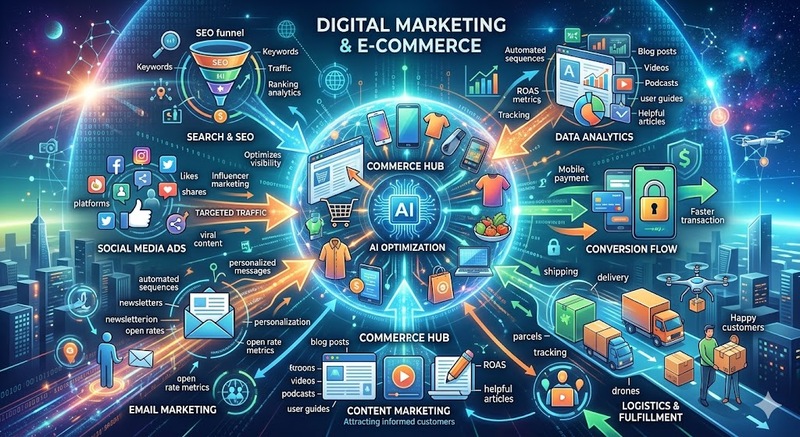
The morning sun filtered through the glass of the coffee shop, but Maya’s attention was entirely locked on her laptop screen. As the founder of Solis Goods, an e-commerce brand selling ethically sourced, high-end home goods, she was facing the modern retail gauntlet.
It was 2026. The digital marketplace had fundamentally changed. Third-party cookies were completely dead, AI search assistants were answering consumer questions before they ever hit a traditional search engine, and privacy regulations were tighter than ever.
Sitting across from her was Leo, a veteran digital marketing strategist. Maya rubbed her temples. "The old playbook is broken, Leo. My ad costs are up, and with the new privacy laws, I feel like I'm flying blind. How do I scale without being creepy, getting penalized, or burning my margins?"
Leo smiled, taking a sip of his espresso. "You don't fly blind, Maya. You change how you see. In 2026, the safest and best practices in e-commerce aren't about hacking the system; they are about trust, transparency, and technical foundations."
He pulled up a digital notepad. "Let’s break down the rules of the game today."
1. Zero-Party Data: The Ultimate Privacy Shield
"First," Leo said, tapping the screen, "we stop chasing people around the internet with third-party tracking. It’s a security risk and consumers hate it. Instead, we use Zero-Party Data—information customers willingly and explicitly share with you."
The 2026 Shift: Instead of buying list data, brands build interactive, value-driven experiences on their own sites to learn about their audience directly.
Maya nodded. "Like a style quiz?"
"Exactly. Look at the difference in how we approach data now."
| Strategy | Pre-2026 Approach (Risky & Deprecated) | 2026 Best Practice (Safe & Compliant) |
|---|---|---|
| Data Collection | Tracking pixels and cross-site cookie monitoring. | On-site quizzes, progressive profiling, and transparent account perks. |
| Email Marketing | Blasting the entire list with a single discount code. | Stricter segmentation based on internal purchase history and direct preferences. |
| Data Security | Storing customer data loosely across multiple third-party apps. | Zero-trust data architecture with end-to-end encryption and clear opt-out workflows. |
2. Optimizing for the AI Search Era (GEO)
"Next is how people find you," Leo continued. "Traditional SEO is still alive, but today it's about Generative Engine Optimization (GEO). When a user asks an AI assistant, 'What are the most durable, non-toxic linen sheets?', you need that AI to cite Solis Goods."
Kantar
"How do we force an AI to recommend us?" Maya asked.
"You don't force it; you feed it what it craves: unmistakable authority and clean data."
1
Implement Clean Schema Markup
Technical Foundation
1.Implement Clean Schema Markup:Technical Foundation.
Ensure your product pages have flawless structural data (Schema). The price, availability, materials, and return policies must be perfectly readable by AI web-scrapers.
2
Publish Citation-Worthy Content
Content Strategy
2.Publish Citation-Worthy Content: Content Strategy.
Move away from generic, keyword-stuffed blogs. Publish original data, independent lab tests of your materials, and deep-dive transparency reports. AI models cite original sources, not regurgitated summaries.
3
Cultivate Off-Site Mentions
Brand Authority
3.Cultivate Off-Site Mentions:Brand Authority.
AI engines evaluate your brand based on the whole internet. Encourage real conversations in forums, secure features in niche publications, and build genuine community discussions around your products.
3. Frictionless, Mobile-First Checkout Security
Maya sighed. "Okay, so we get them to the site safely. But our cart abandonment rate is still hovering around 70%. What are we doing wrong there?"
"In 2026, if your checkout takes more than three taps on a phone, it's dead on arrival," Leo said directly. "Over 70% of e-commerce traffic is mobile. Security and speed are the same thing to a consumer's brain."
Leo highlighted three non-negotiable checkout practices:
- One-Click Digital Wallets: Integrating Apple Pay, Google Pay, and secure mobile native payment options eliminates the need for users to type credit card numbers into a browser on a bus or train. Done Web Agency Luxembourg
- The "Let Them Go" Guest Checkout: Forcing a user to create an account and verify their email before they can buy is a massive friction point. Let them buy as a guest, then incentivize account creation on the post-purchase thank you page. Done Web Agency Luxembourg
- Visible Trust Signatures: Displaying your clear 60-day return policy and SSL security tokens directly next to the "Complete Purchase" button—not buried in the footer—lowers buying anxiety right at the finish line. Done Web Agency Luxembourg
The Turning Point
Maya looked at the blueprint Leo had laid out. It wasn't about trying to trick an algorithm or finding a loophole in privacy laws. It was about building a fortress of first-party data, making her website hyper-readable for the tools of 2026, and making the buying process completely without friction for a mobile user.
"It sounds like," Maya said slowly, "the safest marketing strategy is just being a fundamentally good, transparent business."
"Always has been," Leo smiled, closing his notepad. "Technology just finally caught up to force everyone else to do it, too."
Leave a Comment
You must be logged in to post a comment.
Premium Business Solutions